
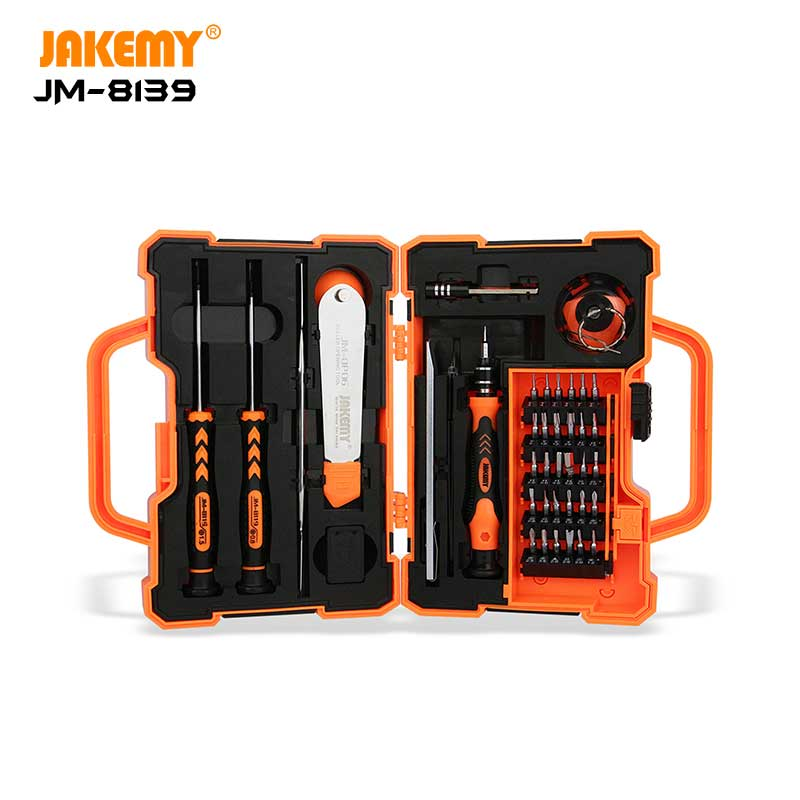
In daily repair and maintenance work, precision screwdriver sets are often compared based on bit variety, storage layout, and handling comfort. Two commonly discussed options in this category are the STREBITO 79 in 1 set and our own solution from Jakemy. Both are designed for structured tasks involving small electronic devices and general household equipment maintenance. While they share a similar purpose, the internal organization and material selection can influence user experience in different working environments. This comparison focuses on practical aspects such as usability, layout design, and long-term handling rather than promotional claims. These observations are based on general product structure and user workflow considerations commonly seen in precision tool applications within maintenance environments without introducing unrelated scope.
Bit assortment and storage layout
STREBITO 79 in 1 set is generally arranged with a wide selection of bits aimed at covering common precision repair scenarios, and its case layout focuses on keeping components visible and accessible. In comparison, Jakemy JM-8172 is designed with a structured internal tray that helps users identify and return bits in a consistent order during repetitive tasks. The arrangement supports organized workflows where tool tracking is important in shared or workshop environments. Both systems prioritize compact storage, but they differ in how components are grouped and accessed during use. This difference in layout approach can influence how quickly users adapt to repeated maintenance routines in controlled environments. Such organization also helps reduce time spent searching for specific bits in tasks.
Handling comfort and material choices
When evaluating hand tools for extended use, grip texture and balance play an important role in reducing strain during repetitive operations. STREBITO 79 in 1 set is typically described with a focus on functional grip surfaces and straightforward tool access. In contrast, Jakemy integrates ergonomic considerations into its overall structure, with the Jakemy JM-8172 reflecting attention to handle materials such as ABS, TPR, and TPU for controlled handling. These material choices aim to support stable operation across different precision tasks without introducing unnecessary complexity in use. Users working in environments with repeated precision tasks may find ergonomic balance and material feedback relevant to long sessions. Both sets therefore support structured use without unnecessary handling variation issues.
Conclusion
Overall, both tool sets address precision assembly needs with different internal structuring approaches that may suit varying working habits. The STREBITO 79 in 1 set provides a familiar reference point for users who prefer a broad bit selection in a single organized case. Meanwhile, Jakemy continues to focus on structured design choices, and the Jakemy JM-8172 reflects this approach through its organized layout and material selection. For users comparing these options, the decision often depends on workflow preference and how tool organization supports daily tasks. This comparison highlights how storage design and handling structure can influence user workflow without relying on excessive specification emphasis. Practical evaluation remains important in selection process decisions.