
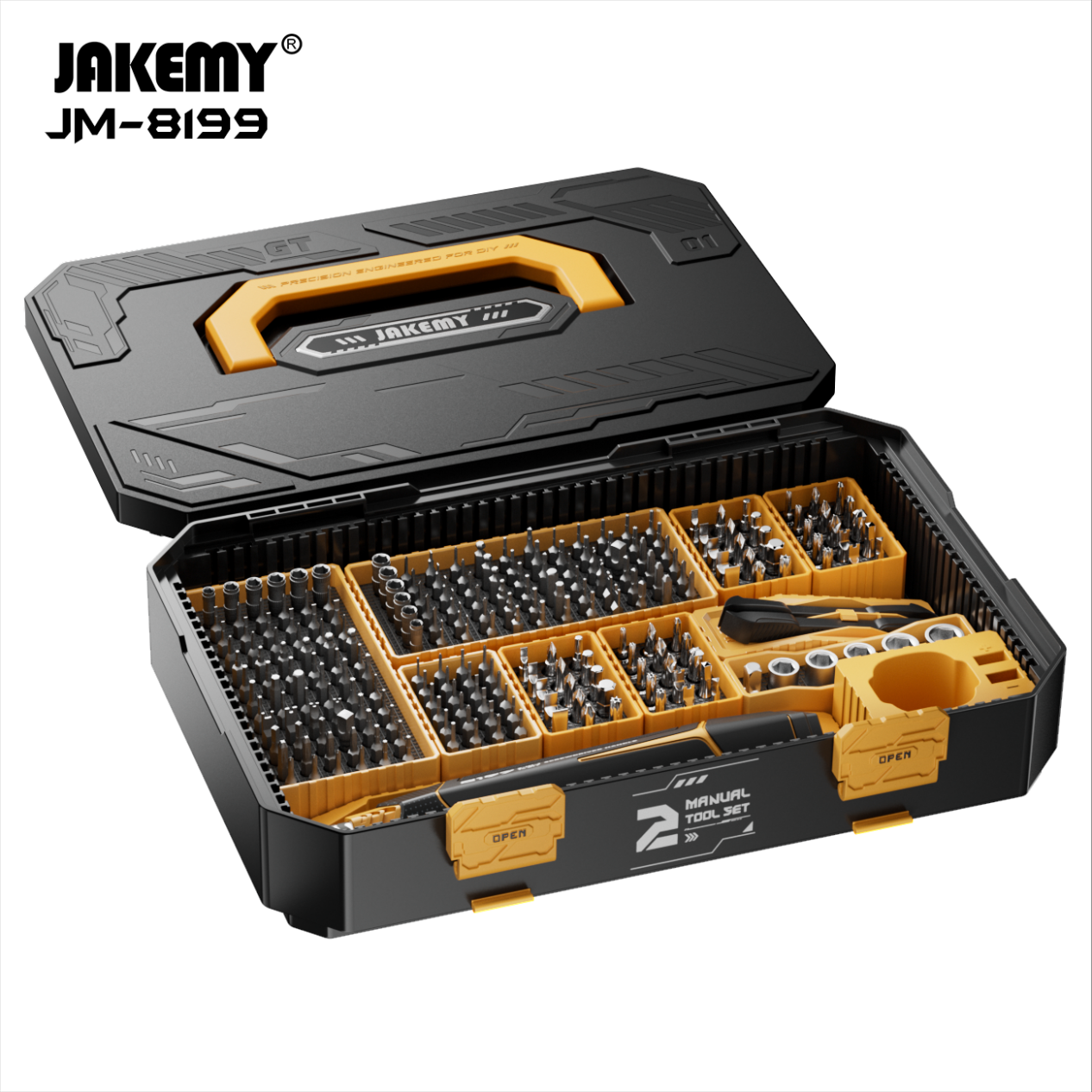
As a team working with professional hand tools for assembly and maintenance workflows, we often evaluate how different precision screwdriver sets support structured operations. In this comparison, we look at Jakemy JM-8199 and the JOREST 152 in 1 Precision Screwdriver Set, focusing on design logic, accessory organization, and usability in controlled working environments. Both solutions are designed for detailed electronic repair tasks, and this review is prepared from our usage perspective. We also consider how storage clarity and tool accessibility influence task efficiency in routine maintenance workflows. This comparison is intended to support procurement teams who assess functional differences between similar tool configurations. We maintain neutral evaluation criteria consistently.
Structured tool configuration of JM-8199
As part of our toolkit evaluation, Jakemy JM-8199 is designed with a compact storage layout that organizes multiple precision bits in a clearly segmented case. The handle is produced using ABS and TPR materials to support a stable grip during continuous tasks, while interchangeable bits are arranged for quick selection without unnecessary searching. This structure helps reduce interruptions in repetitive assembly operations and supports consistent handling in electronics servicing environments. We observe that the compact arrangement reduces misplacement of bits during frequent switching between tasks. Material selection such as ABS and TPR contributes to grip stability without introducing unnecessary complexity in structure.
Overview of JOREST 152 in 1 Set and Comparison
The JOREST 152 in 1 Precision Screwdriver Set provides a wide selection of bit types that support varied fastening requirements across electronic devices. Its storage case is arranged to keep components accessible, and the assortment is designed for users who require flexible coverage of different screw profiles. Compared with this configuration, the alternative set we evaluate focuses more on structured ergonomics and controlled bit alignment, which supports more consistent handling during repetitive tasks in workshop environments. In terms of workflow adaptability, the broader bit coverage of the JOREST set can support varied project requirements. The comparison highlights differences in organization philosophy rather than positioning one option as universally preferable. We also evaluate how case layout influences quick visual identification of tool positions. Such structural considerations are relevant for teams managing repeated electronic assembly processes.
Conclusion
In practical evaluation scenarios, we find that both sets serve electronic assembly tasks with different structural priorities. Jakemy JM-8199 is positioned toward organized handling and stable grip design, which supports consistent workflow in professional maintenance environments. The JOREST option offers broader bit variety for users who prioritize range coverage. Depending on operational needs, selecting between structured ergonomics and wide assortment becomes the main consideration for B2B users reviewing these tool systems. We also note that structured bit alignment can help reduce handling variation during repetitive maintenance cycles. Selection decisions therefore depend on whether a structured grip system or a broader accessory range is more aligned with operational needs. Both sets are commonly evaluated in environments where precision and consistency are required across multiple tasks. This perspective helps technical teams choose configurations that match their operational structure.