
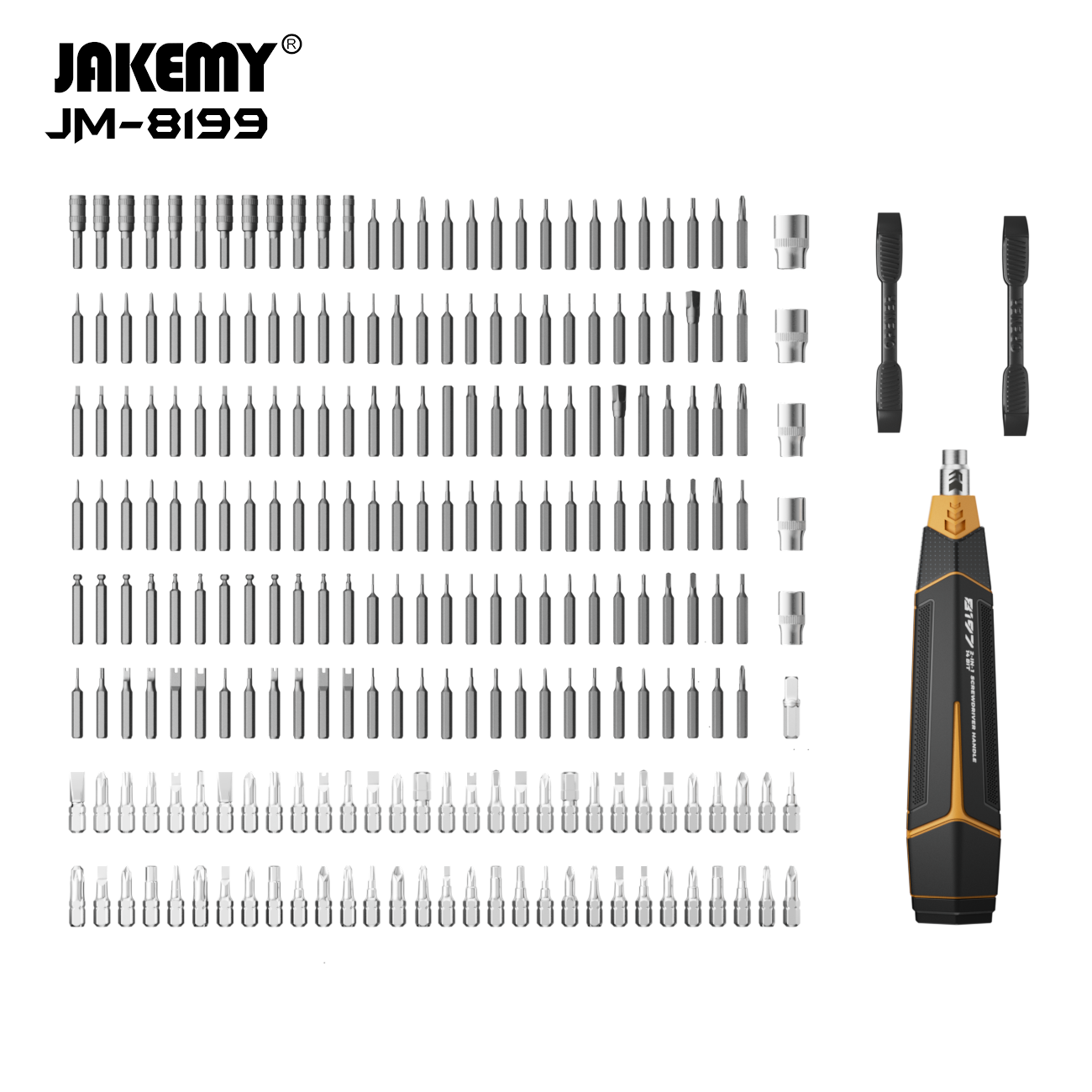
In professional electronics maintenance environments, tool selection often depends on consistency, adaptability, and long-term usability across different repair scenarios. We often evaluate how a toolkit supports structured workflows rather than focusing only on individual components. In this comparison between our solution and the iFixit Pro Tech Toolkit, we focus on practical field requirements and user handling experience. The Jakemy JM-8199 is designed with a modular layout that supports organized bit management and efficient access during tasks involving precision devices. Our company uses this design approach to reduce unnecessary interruption during repetitive operations and to maintain workflow clarity for technical teams working in controlled environments.
Handling design and serviceability insights
When we assess handling characteristics across different tool ecosystems, we observe differences in grip design, bit retention stability, and material selection. In practical scenarios, the Jakemy JM-8199 is structured to support repetitive precision work with consistent tool alignment and accessible storage layout. Compared with the iFixit Pro Tech Toolkit, our evaluation focuses on workflow continuity rather than isolated feature comparison.Material durability considerations also play a role when we evaluate long-term use in structured repair environments. We also consider how organized bit storage and clear labeling can reduce time spent searching for components during maintenance tasks. The comparison with iFixit Pro Tech Toolkit helps highlight differences in system orientation and user workflow planning.
Toolkit ecosystem and field usage
In professional repair environments, toolkit ecosystems are often evaluated based on modularity, maintenance consistency, and adaptability across different electronic device categories. The iFixit Pro Tech Toolkit is frequently referenced for its structured organization and broad compatibility with precision repair tasks. In our internal application review, we also observe how workflow planning can vary depending on technician experience and equipment availability. This helps us refine how we design supporting systems for technical teams working in controlled service settings.We also take into account documentation practices that support repeatable procedures across service operations. Such considerations are important when comparing different toolkit approaches in structured environments. We ensure that component access and organization remain consistent across various field scenarios. This perspective helps align tool system design with real operational requirements. We also evaluate how standardized tool layouts influence error reduction during repetitive maintenance procedures in structured service workflows. These insights are particularly useful when aligning toolkit design with expectations from engineering teams operating in controlled environments. We continuously review these factors to improve system coherence within professional contexts consistently.
Conclusion: alignment of tool selection considerations
From our comparative review, we see that both tool systems are designed to support precision electronics work, yet they differ in organization approach and workflow structure. The Jakemy JM-8199 is often considered in environments where structured bit management and consistent handling are required across repeated technical tasks. Our company continues to refine tool system integration based on real field feedback and operational needs. We ensure that observations from both systems inform practical decision-making for technical teams. This approach allows us to maintain clarity when supporting diverse maintenance workflows.