
When an ultrasonic cutter is used regularly in a repair workshop or model-making operation, the cutting tool itself is only part of the workflow. Operators may also need to trim excess material, remove burrs, smooth edges, handle small components, or separate bonded surfaces. Choosing the right replacement parts and supporting tools helps teams match each step to the material and finish required. At Jakemy, we recommend starting with the actual task rather than purchasing accessories simply because they are included in a large set. This makes an ultrasonic cutter accessory kit more useful for professional workflows and easier to specify for repeat orders.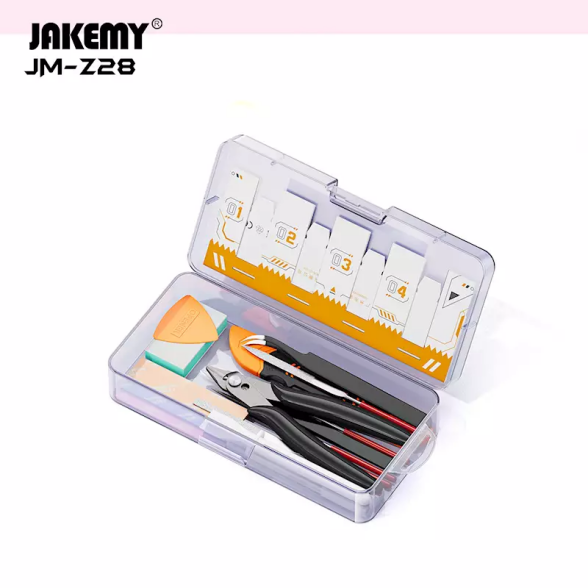
Identify Which Part of the Workflow Needs Support
Before selecting replacement parts, clarify what needs to be replaced and what the next operation requires. A worn or damaged cutting blade is different from a file used for surface finishing, and neither serves the same purpose as a pry tool used during disassembly.
For procurement teams, this distinction matters. Buying additional blades will not solve a problem caused by poor surface finishing, while adding more hand tools may not address a cutter’s compatibility requirements. Start by listing the operations performed most often, the materials handled, and the accessories that are missing or wearing out.
It is also important to distinguish machine-compatible components from general finishing tools. Replacement blades and blade holders must match the relevant cutter configuration. Files, tweezers, and pry tools support related tasks but should be considered separately when planning replacement-blade purchases.
Match Cutting Accessories to Material and Precision Requirements
Different materials and cutting paths call for different blade geometries. For example, a narrow blade can help operators reach confined areas, while a blade with a broader contact area may be more appropriate for other routine cuts. The correct choice depends on the material, cutting direction, required detail, and operator technique.
For compatible JM-Y10 and JM-Y10 Pro models, we offer several replacement blade options, including 30° and 60° fine-point blades, a 30° narrow-point blade, a narrow chisel blade, and a straight cutting blade. Each type serves a different cutting requirement. Fine-point blades are suitable for detailed work where precise positioning matters, while the narrow-point design can help operators access confined areas. A narrow chisel blade is useful for grooving softer materials, whereas a straight cutting blade can support broader peeling tasks. Selecting the appropriate blade geometry helps operators match the tool to the cutting path rather than relying on one blade for every application.
Material compatibility also deserves attention when selecting replacement blades. Plastics, resin, acrylic, leather, carbon-fiber board, and other materials can respond differently to cutting, so buyers should consider the material and the required cut when choosing a blade profile. Test the selected blade on a suitable sample when the material or process is new, and follow the cutter’s operating guidance. For repeat orders, record the blade type and compatible cutter model to help maintain consistent purchasing specifications.
For distributors, this information can make product selection more precise. Instead of asking only for replacement blades, ask customers which materials they process and whether they need general cutting, confined-area work, or surface refinement. Our JM-Y10 accessory options provide a reference for checking available configurations.
Choose Finishing Tools for the Result You Need
Cutting is rarely the final step in model making or precision repair. Edges may need smoothing, gate marks may require removal, and small surfaces may need additional polishing before assembly. In these situations, supporting tools can be just as important as the cutter.
The JM-Z28 accessory kit includes supporting tools for trimming, sanding, polishing, handling, and assembly, such as a model nipper, files, a nano glass file, sponge sandpapers, tweezers, a scraper roller, and pry tools. These accessories can support post-cutting tasks, including burr removal, edge smoothing, small-part handling, and disassembly. However, they serve different purposes from replacement blades and should be selected according to the finishing requirements of the application.
Selecting these tools according to the required finish can reduce unnecessary tool changes and make workstations easier to organize. However, no accessory guarantees a particular finish on every material. Operators should select an appropriate abrasive, apply controlled pressure, and check the result as they work.
Check Compatibility Before Ordering Replacement Parts
Compatibility should be confirmed before a purchase order is issued. Similar-looking accessories may have different dimensions, holders, or intended applications. A blade designed for one cutter series should not automatically be treated as compatible with another.
At Jakemy, replacement blade options are available for compatible JM-Y10 and JM-Y10 Pro models, while the JM-Z28 is a finishing accessory kit designed to accompany the JM-Y09, JM-Y10, and JM-Y10 Pro cutter sets. These products serve different purchasing needs. Buyers looking for replacement cutting blades should specify the required blade type and compatible cutter model separately rather than assuming that the finishing kit includes replacement blades.
For repeat purchasing, record the cutter model, accessory name, required quantity, and intended use in the procurement list. If a customer requires a customized kit, confirm the individual components and compatibility details before finalizing the configuration. This is especially useful for distributors supplying multiple workshops with different equipment.
Evaluate the Supplier for Ongoing B2B Needs
For commercial buyers, choosing an ultrasonic cutter parts supplier involves more than comparing the contents of one package. Consider whether the supplier can identify compatible accessories, clarify what is included, support repeat orders, and discuss customization when standard configurations do not meet the application. For replacement blade procurement, buyers should also confirm the availability of individual blade types, model compatibility, and the supplier’s ability to support consistent specifications across repeat orders.
Our JM-Z28 page lists a minimum order quantity of 100 pieces, sample support, and OEM/ODM options. We also support customization of individual parts within the relevant accessory offering. These options can help distributors and tool brands build assortments around their customers’ actual workflows instead of stocking every accessory indiscriminately.
Before placing a bulk order, confirm the latest configuration, availability of the required individual parts, packaging, and lead time directly with the supplier. Product configurations may change, so the final order should follow the current quotation and confirmed specification.
Build a More Practical Accessory Selection
The most useful replacement-parts plan begins with the work: identify the material, define the cutting or finishing operation, check model compatibility, and order only the components that address a real need. Keep cutting blades separate from general finishing accessories in your inventory records, and document which models each component supports.
With the JM-Z28 kit and model-specific accessory options, Jakemy supports buyers looking to organize tools for model making, electronics repair, and detailed finishing. A clear task-based selection process helps B2B customers make more informed purchasing decisions and gives distributors a stronger basis for recommending the right accessories.