
Choosing an ultrasonic cutter for a production workflow or product lineup involves more than comparing power ratings. Material requirements, operating time, mobility, blade options, and maintenance arrangements all influence whether a tool fits the job.
At Jakemy, we offer the JM-Y09 and JM-Y10 series for different working preferences: the JM-Y09 prioritizes cordless flexibility, while the JM-Y10 is designed for corded operation without an internal battery. Understanding these differences helps distributors, workshops, model-making businesses, and industrial users select a tool that matches their actual requirements.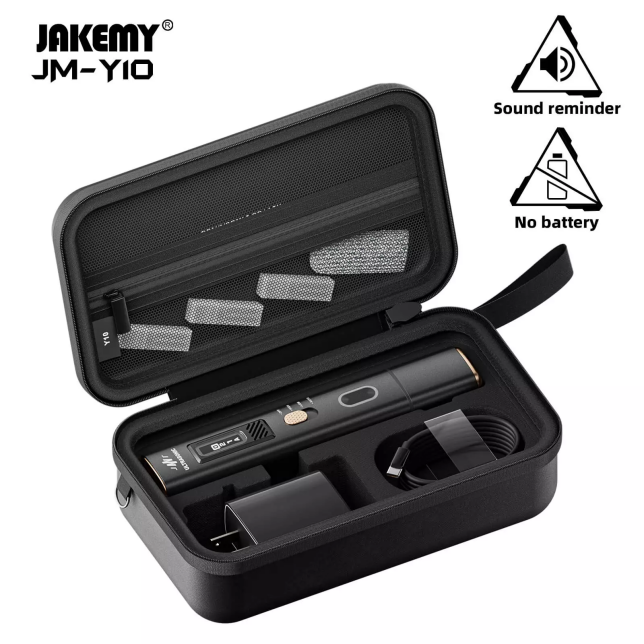
How Do the JM-Y09 and JM-Y10 Differ in Power and Operation?
The most important difference is their power configuration. Our JM-Y09 uses a rechargeable 1,000 mAh battery and supports cordless operation as well as use while connected to power. Its specifications list a 30W rated power, with adaptive output up to 40W. This arrangement suits users who need to move between workstations or handle projects where a cable could restrict access.
The JM-Y10 and Jakemy JM-Y10 pro models use a corded design without an internal battery. The series features a 35W ultrasonic system operating at a true 40kHz frequency. For users working at a fixed bench, this configuration avoids relying on an internal battery for operation.
These ratings should not be treated as a direct measure of cutting speed across every material. Results also depend on blade geometry, material thickness, cutting technique, and operating conditions. For B2B buyers, the practical question is whether the power arrangement matches the intended workflow.
Which Model Is Better for Different Materials?
Both series support cutting and surface-finishing applications, but the appropriate choice depends on the material and the task.
The JM-Y09 supports cutting, grinding, and polishing for applications such as 3D-printed parts, scale models, crafts, and PCB-related work. Its five specialized SK5 steel blades and polishing stick provide options for different cutting angles and finishing requirements.
The JM-Y10 series also supports precision cutting, grinding, and polishing. The official product page lists compatible applications involving carbon fiber, acrylic, leather, metals, wood, 3D-printed resin, PCBs, and other materials. The JM-Y10 Pro adds specialized blade options, including a 60° fine-point blade, a 30° narrow-point blade, a narrow chisel blade, and a straight cutting blade, providing additional choices for specific cutting and finishing tasks.
When comparing a Jakemy ultrasonic cutter for commercial use, buyers should map blade options to their actual materials and processing requirements. A workshop producing detailed scale models may prioritize narrow blades, while a business handling broader trimming and finishing tasks may need a different assortment. Always test compatibility and follow the tool’s operating guidance before processing unfamiliar materials.
Does Cordless Flexibility or Continuous Bench Use Matter More?
The JM-Y09’s replaceable battery is useful for teams that value mobility. Technicians can move the tool between work areas without depending on a nearby outlet, and the battery can be replaced when necessary. Its OLED display reports operating information such as battery level, internal temperature, power load, and current mode. The tool also features a cooling fan and a smart sleep function that activates after the device remains horizontally stationary for 10 seconds in AUTO mode.
The JM-Y10 series takes a different approach. Its corded configuration removes the need to manage an internal operating battery, making it a candidate for fixed workstations where power access is available. Its OLED interface provides operating information, including mode status and temperature monitoring, while the design incorporates dynamic cooling.
For procurement teams, the choice comes down to the work environment. Mobile operators may prefer the freedom of the JM-Y09, whereas production benches with stable power access may favor the JM-Y10. Neither configuration is automatically superior for every project.
What Should You Know About Blade Selection and Safety?
Blade selection affects access, control, and the finish of the processed material. A narrow blade may be useful for detailed work in restricted spaces, while a wider or straight blade may suit different trimming tasks. The JM-Y09 includes five specialized blades and a polishing stick; the JM-Y10 Pro offers additional blade configurations compared with the standard JM-Y10.
Both series also incorporate features intended to help users monitor operation. Depending on the model, these include display feedback, cooling arrangements, and visual status indicators. The JM-Y10 series additionally lists a child safety lock switch and front LED lighting.
These features support operation but do not replace safe working procedures. Users should secure the workpiece, use appropriate eye protection, keep hands clear of the blade path, and follow the manufacturer’s instructions for blade replacement. Material-specific precautions are also important, particularly when cutting composites, plastics, or other materials that may generate hazardous dust or fumes.
How Should B2B Buyers Compare Total Practical Value?
For distributors, OEM/ODM partners, and professional workshops, product selection should consider more than the initial specification sheet. Review the target application, required blade assortment, power access, portability needs, and expected maintenance arrangements.
The JM-Y09 product page lists an MOQ of 200 pieces, while the JM-Y10 series page lists an MOQ of 100 pieces. Both pages indicate sample availability and OEM/ODM or customization support. Buyers should confirm current commercial terms, accessory configurations, and regional power-adapter requirements with our team before placing a bulk order.
It is also worth considering how each model fits into an existing product range. A cordless model can serve customers who prioritize portability, while a corded model may appeal to users who prefer a fixed workstation setup. Offering both options can help distributors address different customer needs without presenting one configuration as suitable for every application.
Which Jakemy Ultrasonic Cutter Should You Choose?
Choose the JM-Y09 when cordless flexibility, a replaceable battery, and movement between work areas are priorities. Consider the JM-Y10 when a corded setup suits your workflow, and evaluate the Jakemy JM-Y10 pro if your project requires its additional specialized blade options.
At Jakemy, we recommend comparing the complete configuration with your material, working environment, and purchasing requirements before making a decision. The right ultrasonic cutter is the one that fits the job consistently—not simply the one with the higher headline specification.