
A cutting mat can remain usable long after its first visible marks appear, but that does not mean every worn mat should stay on the workbench. In repair workshops, inconsistent cutting surfaces can affect positioning, work quality, and the protection of the bench underneath. Replacing mats too early wastes usable supplies, while replacing them too late can create avoidable workflow problems. At Jakemy, we recommend establishing a condition-based replacement process that reflects actual usage, material requirements, and the needs of each workstation rather than relying on an arbitrary calendar date.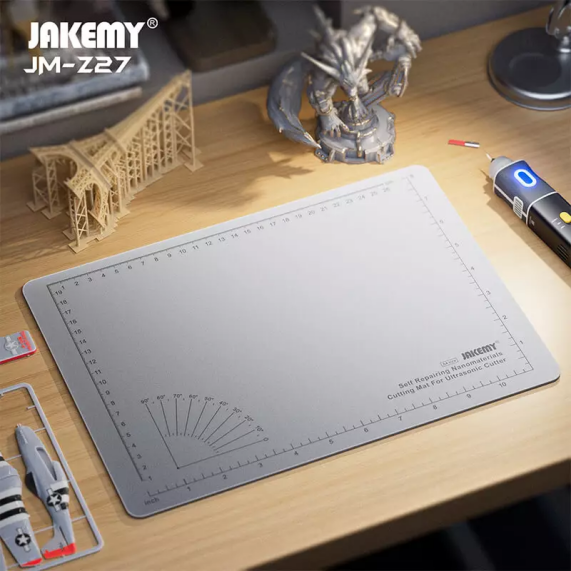
Define What a Usable Cutting Mat Looks Like
Before setting a replacement schedule, repair businesses need a shared standard for acceptable mat condition. Without one, technicians may continue using heavily marked surfaces while other staff replace mats that still perform adequately.
Start by inspecting the surface for deep grooves, persistent deformation, loose or damaged areas, and scale markings that are difficult to read. Pay attention to whether cuts remain stable and whether the mat still provides an appropriate protective layer between the tool and the workbench. A self-healing surface can recover from light cutting marks, but this feature should not be interpreted as an ability to repair every kind of damage.
Our JM-Z27 self-healing nanomaterial cutting mat is designed for ultrasonic cutters, polishers, and precision repair work. Its wear-resistant, tear-resistant material helps withstand repeated use, while its inch and centimeter scales support measurement and positioning. These features make it a practical option for workstations that perform detailed cutting tasks regularly.
Classify Workstations by Cutting Intensity
Not every workstation needs the same replacement interval. A technician who occasionally trims plastic components will place different demands on a mat from a team that performs cutting and finishing tasks throughout the day.
We suggest grouping workstations into usage categories based on actual workload. A low-use bench may need only periodic inspection, while a high-use station may require checks at the start of each shift. Work involving repeated cuts in the same area deserves particular attention because localized wear can develop even when the rest of the surface looks acceptable.
For repair businesses operating multiple locations, standard categories make inspections easier to manage. Record the type of work performed, approximate daily usage, and the areas of the mat that receive the most contact. After collecting observations for several weeks, managers can establish an initial inspection frequency and adjust it based on the condition of mats in each category.
This method is more reliable than assigning every workstation the same replacement date. It also helps procurement teams estimate demand using actual consumption rather than broad assumptions.
Set Replacement Triggers Instead of Guessing a Fixed Lifespan
A standardized process should identify the conditions that require replacement. Deep cuts that no longer provide a stable working surface, damaged areas that interfere with positioning, and markings that cannot be read clearly are reasonable triggers for closer assessment. If the mat no longer protects the bench adequately or cannot support the required precision, replacement should not be postponed simply because its scheduled review date has not arrived.
At the same time, superficial marks alone do not necessarily mean a self-healing mat has reached the end of its useful life. Staff should evaluate the working area, not just the overall appearance.
A simple inspection record can include the workstation number, inspection date, observed damage, action taken, and replacement date if applicable. This creates a history that supervisors can use to identify patterns. If several mats at one station wear out unusually quickly, the cause may involve cutting technique, workload, tool handling, or repeated use of a small section of the surface.
Match Mat Specifications to the Work
Replacement planning also requires consistency in the products being purchased. Differences in size, thickness, surface markings, and material can affect how a mat fits into an established workstation.
The JM-Z27 measures 310 × 230 × 3 mm and weighs 277 g. Its nanomaterial construction, self-healing surface, and inch-and-centimeter scale markings are intended to support precision cutting and repair-bench applications. The mat is also designed with heat resistance for relevant cutting and finishing tasks.
When selecting a cutting mat for ultrasonic cutter applications, buyers should consider the cutter model, working area, materials being processed, and the manufacturer’s operating guidance. Heat resistance does not mean a mat is suitable for unlimited exposure to every temperature or cutting condition. Technicians should follow equipment instructions and avoid treating the mat as a substitute for safe tool operation.
For businesses using several mat models, keep the approved specifications in the purchasing record. This helps prevent accidental substitutions that may not fit the bench or the intended process.
Build Replacement Planning Into Procurement
Once inspection rules are established, purchasing teams can use maintenance records to plan replenishment. Track how many mats are in service, how many were replaced during each period, and which workstations consume the most stock. These figures help estimate demand and reduce both emergency purchases and unnecessary overstocking.
For distributors and repair-tool suppliers, clear replacement criteria also make customer support more useful. Instead of recommending a new mat after a fixed number of weeks without considering actual use, staff can explain the inspection factors and help customers choose a suitable product configuration.
At Jakemy, we support business buyers with wholesale and customization options for the JM-Z27. The official product page lists a minimum order quantity of 100 pieces and sample support. Buyers should confirm current specifications, availability, packaging, and delivery timing before arranging repeat orders.
Make the Standard Easy for Staff to Follow
A replacement policy only works when technicians can apply it without slowing down their jobs. Post a short inspection checklist near each workbench, assign responsibility for routine checks, and explain when damage should be reported. Managers can review records monthly at first, then adjust the review frequency once usage patterns become clearer.
A precision cutting mat should be assessed according to the work it supports, not simply its age or appearance. By combining shared inspection criteria, workstation-level usage records, and consistent purchasing specifications, repair businesses can make replacement decisions more predictable.
The goal is not to replace every mat as frequently as possible. It is to keep each station equipped with a surface that remains appropriate for its tasks, while giving procurement teams reliable information for planning. With the JM-Z27 and a documented condition-based process, Jakemy customers can manage cutting-mat supplies with greater consistency across individual benches and larger repair operations.