
Buying workshop tools individually can seem economical until a project requires another file, a suitable polishing tool, or tweezers for handling a small component. For model-making suppliers, electronics repair businesses, and tool distributors, these additional purchases affect inventory planning as well as the time technicians spend switching between tasks. At Jakemy, we approach accessory kits as practical combinations of tools that support different stages of precision work. The question is not simply how many items a kit contains, but whether those items justify the investment.
 When does a complete accessory kit offer better value?
A complete kit can be useful when a workflow involves several operations rather than cutting alone. A technician might trim a plastic component, remove burrs, smooth an edge, and prepare the surface for assembly. Buying a separate tool for each step can create a fragmented setup, particularly when staff work with small parts throughout the day.
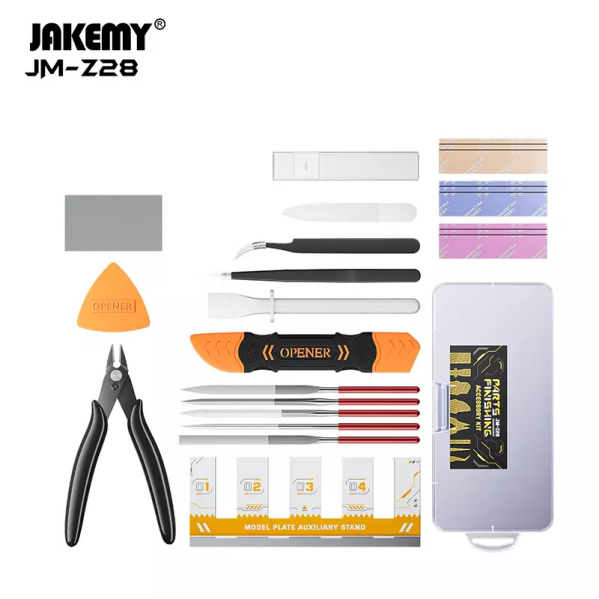
Our JM-Z28 ultrasonic cutter accessory kit brings together tools for cutting, sanding, polishing, handling, and assembly. It is designed for applications including model making, electronics repair, precision instrument maintenance, handicrafts, and detailed finishing work. This combination gives business buyers an opportunity to equip a workstation with tools for related tasks instead of sourcing every accessory separately.
However, a complete set is not automatically the most economical option. If a workshop only needs one specialized file, purchasing a full kit may create unnecessary inventory. Buyers should compare the included tools with their actual workload before deciding.
How can you calculate the value beyond the purchase price?
The initial price is only one part of the cost. Procurement teams should also consider how many separate orders are required, how much storage space accessories occupy, and whether technicians lose time locating missing tools. These factors are difficult to measure without operational data, but they can help explain why a coordinated kit may offer better value over time.
For example, a workshop that regularly trims, files, and polishes model components may use several items from the JM-Z28 during one project. A business performing only occasional cutting may use fewer accessories. The same kit can therefore deliver different levels of value depending on task frequency.
We recommend reviewing recent repair or production jobs and recording which tools operators use most often. Compare that list with the kit contents, then identify any gaps or items unlikely to be used. This simple assessment provides a stronger purchasing basis than piece count alone.
Which tools make a difference in daily work?
The JM-Z28 includes a model nipper, a file set, a nano glass file, a polishing block, three sponge sandpapers, an auxiliary stand, a parts box, two tweezers, a scraper roller, and disassembly tools. Each serves a different purpose within the broader finishing workflow.
The nipper is intended for cutting plastic model parts and copper wire. Files help shape surfaces and remove burrs, while the nano glass file supports gate removal and surface refinement on suitable materials, including plastic, resin, acrylic, and glass. The polishing block and sponge sandpapers accommodate finishing work on curved or detailed surfaces.
Tweezers help operators handle small components, and the scraper roller supports more controlled adhesive application. Pry tools assist with separating connected surfaces during disassembly. Together, these tools cover more than one stage of a job, although the appropriate tool and technique still depend on the material and application.
For businesses supplying model-making or electronics repair equipment, this functional range can make the ultrasonic cutter accessory kit relevant to customers whose work extends beyond cutting.
Should you buy accessories separately or as a set?
Separate purchases offer flexibility when a business has highly specialized requirements. They also allow buyers to replenish a frequently used item without purchasing duplicates. The disadvantage is that individual products may arrive from different suppliers, with separate ordering, packaging, and delivery arrangements.
A complete kit simplifies selection when customers need a range of complementary tools. It can also make product assortment planning more straightforward for distributors building a dedicated category around ultrasonic cutters and surface finishing.
At Jakemy, the JM-Z28 accessories are available for use with our JM-Y09 (UC02), JM-Y10, and JM-Y10 Pro ultrasonic cutter series. We also support customization of individual parts within the set. Buyers can therefore discuss whether a complete configuration or selected components better fit their product strategy. Compatibility and the final accessory configuration should be confirmed before an order is placed.
What should B2B buyers ask the supplier?
A sensible evaluation covers more than the item list. Distributors should confirm the minimum order quantity, sample availability, packaging requirements, customization scope, and expected production lead time. These details influence the cost and practicality of introducing a new accessory line.
Our JM-Z28 has a listed minimum order quantity of 100 pieces, with sample support available. We offer wholesale, OEM, and ODM options for business customers.
Before committing to volume, buyers can request a sample and evaluate whether the included tools meet their customers’ needs. They should also clarify how individual accessories can be ordered, how product changes are communicated, and what information will appear on packaging. These questions help establish a workable purchasing plan rather than focusing exclusively on the initial quotation.
How can you make the investment work harder?
A kit creates value when its contents are accessible, maintained, and used appropriately. Keep small parts organized, inspect cutting and finishing tools regularly, and replace damaged items when necessary. Staff should also follow the tool manufacturer’s guidance and use suitable protective equipment for the materials and operations involved.
For distributors, product education matters too. Explain the role of each accessory and the applications the kit is designed to support. This helps business customers judge suitability more accurately and reduces the chance of purchasing based on an unrealistic expectation.
Ultimately, the ultrasonic cutter replacement parts and finishing accessories a business needs depend on its workload, not on the size of its catalog. At Jakemy, we designed the JM-Z28 to bring complementary tools together for model repair, electronics work, and surface finishing. If your customers regularly move between trimming, shaping, polishing, and assembly, a complete kit may simplify procurement and workflow. If their needs are narrow, a smaller selection may be more appropriate. The best investment is the configuration that earns its place on the workbench.