
When a workshop processes 3D-printed models, plastic components, or small precision parts, the work surface can influence both cutting control and daily maintenance. Repeated blade contact may leave marks on an ordinary tabletop, while an unsuitable mat can make measuring and positioning more difficult. For tool distributors and professional workshops, choosing a cutting mat for ultrasonic cutter applications means considering material, durability, dimensions, and compatibility with the tools customers already use. At Jakemy, we develop cutting accessories to support practical precision work.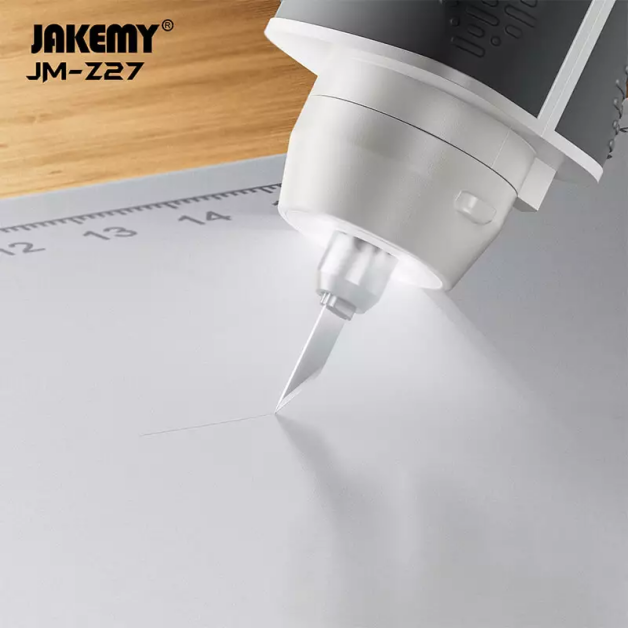
Why does the cutting surface matter?
An ultrasonic cutter is used for detailed cutting tasks where control over the blade path is important. Depending on the material and application, operators may trim plastic, remove support structures from 3D prints, cut leather, or refine model components. These tasks can involve repeated strokes in a relatively small working area.
A suitable cutting mat provides a dedicated surface between the blade and the workbench. It helps protect the underlying tabletop from direct cutting contact and provides a consistent area for positioning small parts. However, a mat should not be expected to eliminate every mark or prevent every cutting accident. Its effectiveness depends on the material being processed, blade condition, applied pressure, and maintenance practices.
For businesses purchasing workshop accessories, the key question is whether the mat suits the actual workload. A model-making studio may prioritize fine measurement markings, while a repair workshop may value a durable surface that can withstand repeated use.
Which material properties should you compare?
Material selection affects how a mat responds to repeated cutting and handling. A surface that wears quickly may need frequent replacement, increasing the cost of maintaining multiple workstations. Buyers should therefore examine the manufacturer’s stated material, resistance properties, and intended applications instead of judging quality by appearance alone.
Our JM-Z27 uses nanomaterial and is designed as a self-healing cutting mat for ultrasonic cutters and polishers. Its listed properties include wear resistance, tear resistance, abrasion resistance, and high-temperature resistance. The self-healing design helps the surface recover from light cutting marks, although the extent of recovery depends on the depth and nature of the damage.
For procurement teams, these characteristics provide a starting point for comparing products. Ask suppliers to clarify the intended use conditions and any maintenance limitations. A cutting mat is a consumable workshop accessory, and deep cuts, excessive pressure, or unsuitable use may still damage its surface.
How do size and thickness affect usability?
A mat must accommodate the parts being processed without taking up unnecessary bench space. If the usable area is too small, operators may need to reposition components repeatedly. An oversized mat, on the other hand, may be inconvenient for compact repair stations or portable tool kits.
The Jakemy JM-Z27 measures 310 × 230 × 3 mm and weighs 277 g. Its dimensions offer a defined working area for precision cutting, trimming, and repair tasks. Before ordering, compare these measurements with the available workspace and the largest components your customers typically handle.
Thickness also deserves attention. It contributes to the mat’s physical profile and should be considered alongside flexibility, storage requirements, and the intended cutting process. Rather than assuming that a thicker mat is always better, evaluate the complete specification against the workshop’s needs.
Why are measurement markings useful?
Precision work often involves cutting a component to a particular length or aligning an edge before trimming. Without a reference scale, operators may need a separate ruler for each measurement, adding steps to the workflow.
The JM-Z27 includes both inch and centimeter scale markings, allowing users to reference either unit system during positioning and measurement. Its scale is described as non-ink printed, helping keep the surface practical for routine workshop use.
These markings are useful references, but they do not replace calibrated measuring instruments when tight dimensional tolerances are required. For repeatable production tasks, operators should verify critical dimensions with the appropriate measuring tool and follow the relevant work instructions.
How should businesses evaluate compatibility and supply?
A cutting mat is more valuable when it fits naturally into an existing tool setup. Our JM-Z27 is available with the Jakemy JM-Y09 ultrasonic cutter and the JM-Y10 and JM-Y10 Pro models, with individual-part customization also supported. This gives distributors options when assembling tool bundles or replenishing accessories separately.
At Jakemy, we support OEM and ODM customization for business customers. The JM-Z27 has a listed minimum order quantity of 100 pieces, and sample support is available. Before committing to a bulk purchase, buyers should confirm the required quantity, packaging, customization details, and current lead time.
For distributors serving several markets, it is also worth checking whether product dimensions, labeling, and packaging information suit their catalog requirements. Clear specifications make it easier to compare products, communicate with customers, and manage replenishment.
What should you consider when managing cutting mats?
Routine inspection can help workshops identify when a mat is no longer suitable for accurate work. Check for deep grooves, uneven areas, or damage that affects how a component rests on the surface. Clean the mat according to the supplier’s instructions, and avoid treating a self-healing surface as indestructible.
Operators should also use appropriate blades and cutting techniques, keep hands clear of the blade path, and follow the cutter manufacturer’s safety guidance. Heat resistance does not mean that every temperature or cutting condition is suitable for the mat.
For procurement managers, standardizing the mat model across compatible workstations can simplify staff training, purchasing, and replacement planning. Keep the product specification and reorder details available so the next purchase matches the original configuration.
Choosing a mat for long-term workshop use
The right mat should match the materials, measurements, workspace, and cutting frequency involved in daily operations. For businesses evaluating a cutting mat for ultrasonic cutter applications, the JM-Z27 combines a nanomaterial self-healing surface, dual-unit scale markings, and compact dimensions in one accessory.
At Jakemy, we encourage distributors and professional users to assess these features against their actual work rather than relying on broad durability claims alone. A well-matched cutting mat can become a useful part of a precision tool setup, while clear specifications and compatible product options help business buyers plan their inventory with greater confidence.