
A repair technician can have dozens of tools available and still lose time when a particular fastener requires an uncommon bit. For electronics repair shops, maintenance teams, and distributors, the challenge is choosing a screwdriver set that covers real service requirements without creating unnecessary inventory. At Jakemy, we develop precision tool kits for different repair scenarios, and we believe a good buying decision starts with the devices being serviced rather than the number printed on the box.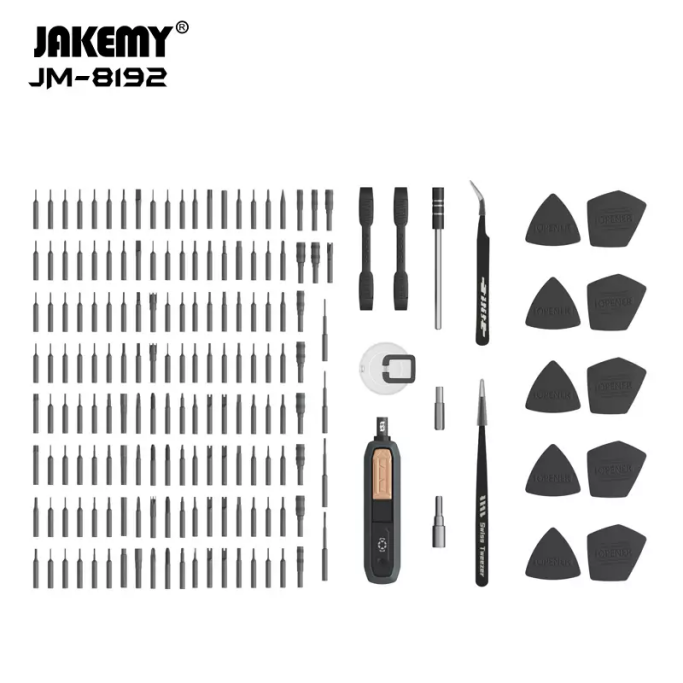
Which precision screwdriver set fits your repair workload?
Start by identifying the equipment your customers handle most often. Smartphones, laptops, cameras, game consoles, and household electronics can use different fastener profiles, including Phillips, Torx, hex, slotted, and specialized security types. A kit that suits a mobile repair counter may not cover every requirement of a multi-device service center.
Our Jakemy JM-8192 is a manual precision screwdriver set designed for electronics maintenance and other small-component work. Its 180-in-1 configuration combines screwdriver bits, sockets, and opening accessories in one compact toolbox. The range includes common profiles alongside specialized options, making it relevant to businesses that need tools for several device categories.
Before ordering, compare the included bit types and sizes against your most frequent repair jobs. If your technicians repeatedly encounter a fastener that is missing from the set, that gap matters more than having several rarely used alternatives.
What should you know about bit materials and variety?
Bit variety is useful only when the tips fit correctly. A mismatched bit can slip, damage the screw recess, or make removal harder. Technicians should select the correct profile and size, keep the driver aligned with the fastener, and replace worn bits when they no longer engage securely.
The JM-8192 uses both CR-V (chromium-vanadium) and S-2 steel bits. Its listed configuration includes 144 CR-V bits with a 4 mm hex shank and four longer S-2 bits with a 4 mm hex shank. The set also includes 14 sockets for different fasteners and applications. These specifications give procurement teams concrete information for comparing material and configuration rather than relying on broad descriptions such as “professional grade.”
A broad selection can be especially useful for distributors supplying repair businesses with different specialties. However, the final choice should still reflect the actual devices and service procedures involved.
Why do opening tools matter in electronics repair?
Disassembly often involves more than removing screws. A technician may need to lift a panel, separate a housing, handle small components, or reach a connector without damaging surrounding parts. A screwdriver-only kit may leave these steps dependent on separate tools.
The JM-8192 includes five opening tools, five ultra-thin opening tools, a suction cup, pointed and curved tweezers, two spudgers, and an extension rod. These accessories support different stages of disassembly and component handling. For example, an appropriate opening tool can help separate a compatible panel, while tweezers can assist with positioning small parts.
The right technique depends on the device. Follow the manufacturer’s service instructions, disconnect power before internal work, and avoid forcing clips or covers that remain attached. Having more accessories does not remove the need for suitable training and careful handling.
How important are storage and portability?
For a repair business, tool organization affects daily workflow. If bits are difficult to identify or frequently misplaced, technicians spend time searching instead of working. Shared kits also need a consistent system for checking that all components are returned after use.
The JM-8192 comes in a white-and-black toolbox measuring 193 × 85 × 85 mm, with a listed single gross weight of 0.880 kg. Its container format brings the kit components together for storage and transport between workstations. Buyers can use these dimensions and weight to assess shelf space, service-bag requirements, and product presentation.
For teams sharing equipment, we recommend returning each component to its designated position and checking for missing or damaged parts regularly. This straightforward routine helps maintain an organized repair station and makes replenishment needs easier to identify.
What should distributors check before purchasing in bulk?
A product can suit the technical requirements and still need careful commercial evaluation. B2B buyers should review minimum order quantities, packaging, sample availability, customization options, and delivery arrangements before committing to a larger purchase.
The JM-8192 has a listed minimum order quantity of 100 pieces and supports OEM and ODM services. Its official product information lists carton packaging at 40 × 28 × 18 cm, with 12 sets per carton and a gross carton weight of 12.05 kg. These details help distributors estimate storage and shipping requirements, although current terms should be confirmed with our team before an order is finalized.
At Jakemy, we manufacture our own branded tools and support business customers with wholesale and customization services. Our product range covers manual and electric screwdriver sets alongside other electronics repair tools. For resellers developing a product line, we recommend discussing the target market, packaging requirements, and expected order volume early in the purchasing process.
How can you choose the right model with confidence?
An ideal set is not necessarily the one with the highest piece count. It is the one whose bit selection, accessories, storage design, and purchasing terms fit the work your customers actually perform. A compact kit may suit a narrow repair specialty, while a broader configuration can be more practical for teams handling varied devices.
We designed the Jakemy JM-8192 to combine a wide selection of bits with sockets and disassembly tools in one organized case. If you are comparing a Jakemy 180 in 1 set with other precision kits, begin with your repair list, verify the exact specifications, and assess which included components will be used regularly. At Jakemy, we aim to help business buyers make product choices based on practical requirements—not piece count alone.