
A clean cut is only one part of precision work. After separating a model component or trimming a small plastic part, technicians may still need to remove burrs, smooth an edge, polish a surface, apply adhesive, or position tiny components for assembly. If these follow-up tasks require several separately sourced tools, workshop preparation becomes more complicated and inventory management takes more effort.
For distributors, repair-tool brands, and professional workshops, choosing an ultrasonic cutter accessory kit means looking beyond the number of pieces in the box. The more useful question is whether its tools support the stages of work that happen before and after cutting. At Jakemy, we approach accessory selection from this practical perspective: match the tool assortment to real applications, then assess compatibility, organization, and purchasing flexibility.
Which Tools Cover the Main Stages of Precision Work?
A well-planned kit should support several related operations rather than focus on just one task. When evaluating a set, buyers can start with four categories.
1.Cutting and trimming tools
Nippers are useful for separating small plastic components and trimming excess material. In model-making workflows, a suitable nipper can help produce a cleaner cut at the connection point. Buyers should consider the materials their customers commonly process and whether the tool is appropriate for the size and type of component.
2.Filing and surface-finishing tools
Files help shape edges, remove burrs, and reach narrow areas that are difficult to finish with larger tools. A kit may also benefit from a nano glass file for detailed work on suitable materials, including certain plastic, resin, acrylic, or glass components. Because surface hardness and fragility vary, users should test the method on a spare piece before working on a finished component.
3.Sanding and polishing supplies
Cutting often leaves a surface that needs further refinement. A polishing block and sponge sandpaper can help users work on flat, curved, or contoured areas. Flexible abrasive materials are especially useful when a rigid tool cannot follow the surface evenly. Buyers should examine whether the assortment supports both preliminary smoothing and finer finishing instead of supplying tools that perform nearly identical functions.
4.Handling, separation, and assembly tools
Tweezers help position small parts without relying entirely on fingers. Pry tools can assist with separating connected components, while a scraper roller can help spread adhesive and control its application during bonding. These tools extend a kit’s usefulness beyond cutting and make it more relevant to repair and assembly workflows.
How Does the Jakemy JM-Z28 Apply This Checklist?
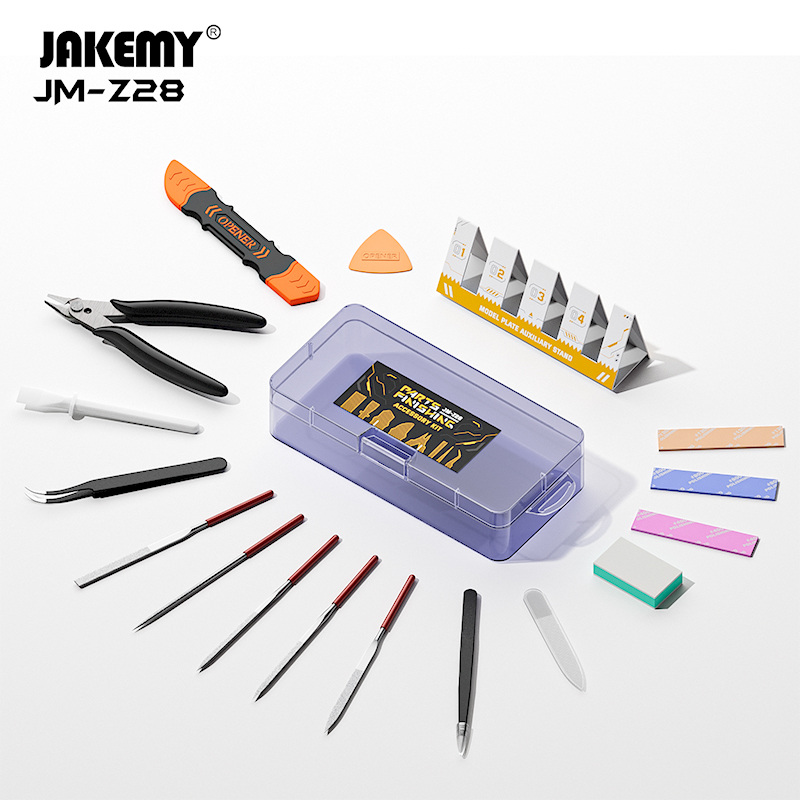
Our ultrasonic cutter accessories range includes the JM-Z28, a parts-finishing kit designed for work involving cutting, sanding, polishing, handling, and assembly. Its configuration brings together several of the tool categories buyers should evaluate when sourcing a multi-purpose accessory set.
The listed contents include a model nipper, a file set, a nano glass file, a polishing block with three sponge sandpapers, an auxiliary stand, a parts box, two tweezers, a scraper roller, and disassembly tools. The tweezers include bent-tip and pointed-tip versions. The disassembly tools comprise a dual-headed pry tool and a triangular pry piece.
This combination is useful to assess as a workflow rather than simply a piece count. A technician may trim a part with the nipper, refine the edge with a file, smooth the surface with an abrasive, and then use tweezers or a pry tool during positioning or assembly. The scraper roller serves a different purpose by helping distribute adhesive more evenly.
The JM-Z28 is intended for applications such as model making, electronics repair, precision-instrument maintenance, handicrafts, leathercraft, bonding, and detailed assembly. The appropriate tool and technique still depend on the material and task; an accessory kit should not be treated as a guarantee that every tool suits every surface.
What Should Buyers Check Before Placing a Wholesale Order?
For B2B purchasers, a technically suitable set is only one part of the decision. Three additional checks can help reduce sourcing problems.
First, confirm compatibility. The JM-Z28 is part of Jakemy’s ultrasonic cutter ecosystem and is compatible with the JM-Y09 (UC02), JM-Y10, and JM-Y10 Pro handheld ultrasonic cutters. Buyers should confirm the intended configuration and whether they need the complete kit or selected individual parts before finalizing specifications.
Second, assess storage and repeatability. A parts box helps keep small accessories together between jobs. For repair businesses, distributors, and training environments, organized storage can also make it easier to check inventory and return tools after use. If a kit will be bundled with a cutter, consider how the accessory assortment fits the overall product offering.
Third, clarify supply requirements. The official JM-Z28 listing specifies a minimum order quantity of 100 pieces and sample support. Jakemy also offers wholesale, OEM, ODM, and customization options for individual parts within the set. These options may be relevant to distributors building their own tool assortments or brands developing a product package for a particular customer group. Confirm the requested configuration, customization scope, and current commercial details with our team before ordering.
Which Accessory Mix Fits Your Customers?
The right kit depends on what customers do most often. Model-making retailers may prioritize trimming, filing, and polishing; electronics repair suppliers may value small-part handling and careful disassembly; workshops that perform bonding and assembly may pay closer attention to tweezers and adhesive tools.
Rather than choosing an ultrasonic cutter accessory kit solely by its headline quantity, compare the operations it supports, the materials involved, the compatibility requirements, and the sourcing options. At Jakemy, we provide the JM-Z28 as one solution for buyers seeking a coordinated set of finishing and handling tools. Reviewing the actual accessory list against your customers’ day-to-day work is a practical starting point for building a product assortment that serves a clear purpose.