
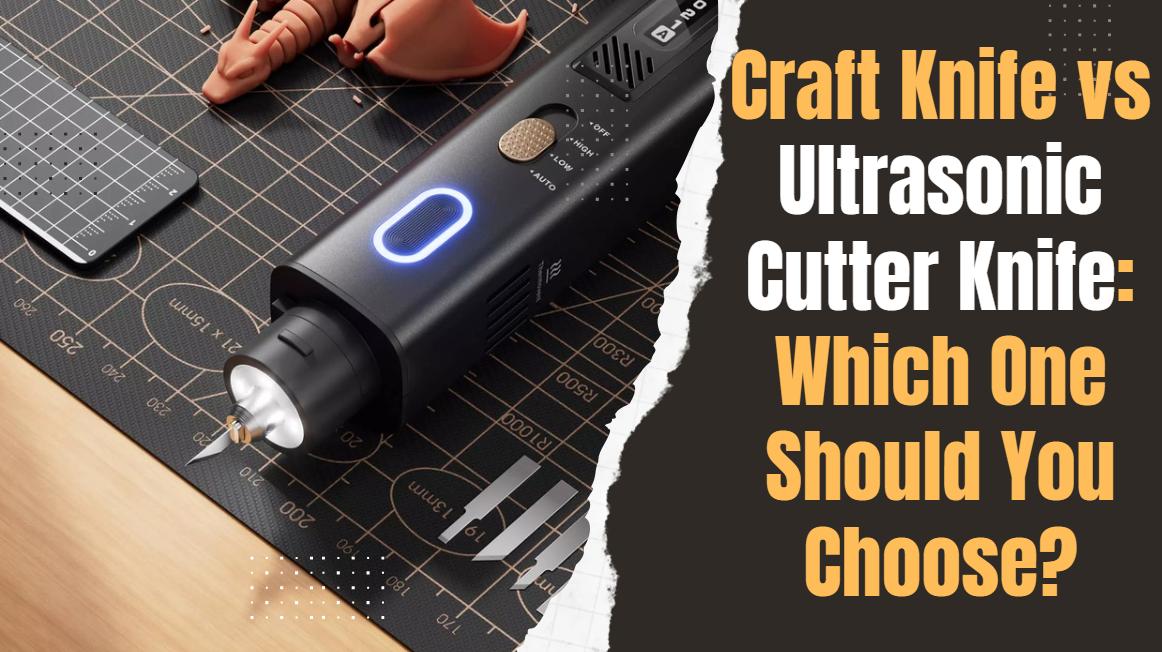
If you only tackle occasional DIY projects or simple cutting jobs, a traditional craft knife is usually sufficient. It is inexpensive, portable, and easy to replace. However, if you are a frequent maker, model builder, product designer, or professional who regularly works with demanding materials, an ultrasonic cutter knife can offer better efficiency, control, and cutting quality.
The right choice ultimately depends on what you cut, how often you work, and how much precision you need. This guide compares the two tools to help you make a more informed purchasing decision.
|
Factor
|
Traditional Craft Knife
|
Ultrasonic Cutter Knife
|
|---|---|---|
|
Working Principle
|
Cuts through hand-applied pressure
|
Uses high-frequency blade vibration
|
|
Precision
|
Relatively low
|
High
|
|
Cutting Quality
|
Depends heavily on blade sharpness and user skill
|
Cleaner edges with less force and deformation
|
|
Ease of Use
|
Simple, but physically demanding on tougher materials
|
Requires power and basic setup, but reduces cutting effort
|
|
Typical Materials
|
Paper, cardboard, thin foam, vinyl, light plastic
|
Plastic, resin, rubber, leather, acrylic, carbon fiber and more
|
|
Typical Price Range
|
About $5–$30
|
About $100–$250
|
|
Best for
|
Casual crafting and light-duty DIY
|
Frequent makers, model builders and professionals
|
Detailed Comparison
1. Working Principle
A craft knife requires the user to apply force and guide the blade through the material. Its cutting performance mainly depends on blade sharpness, cutting angle, hand control, and material resistance.
An ultrasonic cutter knife requires the user to only guide the blade along the cutting path. The blade itself vibrates at ultrasonic frequencies, turning the cut into a rapid series of micro-cuts. This significantly reduces friction and material resistance, so the cutting is smoother.
2. Cutting Precision
For paper, masking film, stickers, and thin cardboard, a craft knife can provide sufficient precision in experienced hands. It is also easy to guide along a ruler.
However, problems may appear when cutting curves, narrow openings, thick plastic, or delicate model parts. Applying greater pressure can make the blade slip or pull the material out of position.
An ultrasonic cutter is generally more capable in these situations. Reduced cutting resistance allows the user to guide the blade with greater control, making it a practical precision cutter for model making, prototyping, 3D-print post-processing, and detailed craft work.
Some users of Bambu Lab and similar 3D printers report that they need to remove support structures after printing, as well as harder residue or hardened material buildup; an ultrasonic cutter can make these post-processing tasks easier by cutting through stubborn material with less force.
3. Cutting Quality
With a traditional craft knife, cutting quality can vary according to the material, blade condition, and user’s technique. Softer materials may deform under pressure, while some fabrics, foams, plastics, or composite materials can require additional finishing after cutting.
Ultrasonic vibration can reduce the force applied directly to the material. As a result, users may achieve cleaner edges and more consistent cuts across suitable materials.
Still, no cutting tool works equally well on every substrate, so material thickness and composition should always be considered before choosing a blade or cutting mode.
4. Ease of Use
A traditional craft knife has one major advantage: simplicity. There is little setup, no electronic system, and replacement blades are widely available. For someone who only needs to cut paper, cardboard, or thin craft materials occasionally, this simplicity is difficult to beat.
An ultrasonic cutter has a higher learning curve. Users need to understand its operating modes, blade selection, and appropriate pressure. Once familiar with the tool, however, the reduced cutting resistance can make repetitive work more comfortable.
5. Use Cases
Craft knives are a practical choice for scrapbooking, paper crafts, packaging prototypes, light DIY work, and other everyday projects.
Ultrasonic cutter knives have a broader potential application range. Depending on the model, they can be used for plastics, acrylic, leather, EVA foam, rubber, wood, carbon fiber, 3D-printed materials, and other substrates.
6. Price Range
Traditional craft knives commonly cost between $5 and $30, depending on build quality, blade system, and included accessories.
Ultrasonic cutters have a higher initial cost. Entry-level models may start at around $100, while professional systems can cost several hundred dollars or more.
7. Best For
Choose a craft knife if you cut lightweight materials only occasionally, value maximum portability, or have a limited budget.
Choose an ultrasonic cutter knife if you regularly work with different materials, require detailed cutting, or want one tool that can support more demanding craft and model-making tasks.
Why Consider the Jakemy JM-Y10 Ultrasonic Cutter?
For users ready to move beyond a conventional craft knife, the Jakemy JM-Y10 is worth considering. It combines ultrasonic cutting with grinding and polishing functions, suitable for materials such as carbon fiber, acrylic, leather, EVA foam, 3D-printed resin, PCBs, wood, plastic, and rubber.
Its key features include:
- 35W, 40kHz ultrasonic system with PZT ceramic components and a titanium alloy transducer
- Aluminum alloy handle for improved heat dissipation
- Dynamic cooling system for more stable operation
- OLED display showing operating mode and temperature
- Front LED lighting for better visibility
For distributors, the JM-Y10/JM-Y10 Pro can complement product lines covering craft knives, model-making tools, DIY equipment, and repair tools. Jakemy also provides OEM/ODM and customization support, with samples available.
Conclusion
A traditional craft knife remains the sensible choice for simple, occasional cutting. It is affordable, convenient, and effective on lightweight materials. However, for frequent or demanding work, an ultrasonic cutter knife offers a meaningful improvement in precision, edge quality, and efficiency. The JM-Y10 brings these advantages together with polishing capability, intelligent controls, and broad material compatibility—making it a strong choice for serious makers, professionals, and distributors alike.