
When a repair team handles dozens of small fasteners every day, the difference between a manual driver and a cordless electric model becomes a practical workflow decision. Faster screw removal can help technicians manage repetitive tasks, but delicate electronics also require controlled torque, suitable bits, and reliable handling. At Jakemy, we design precision screwdriver sets for electronics maintenance and other detailed repair work. For distributors and professional buyers, choosing the right model means evaluating the complete working system rather than focusing on motor speed alone.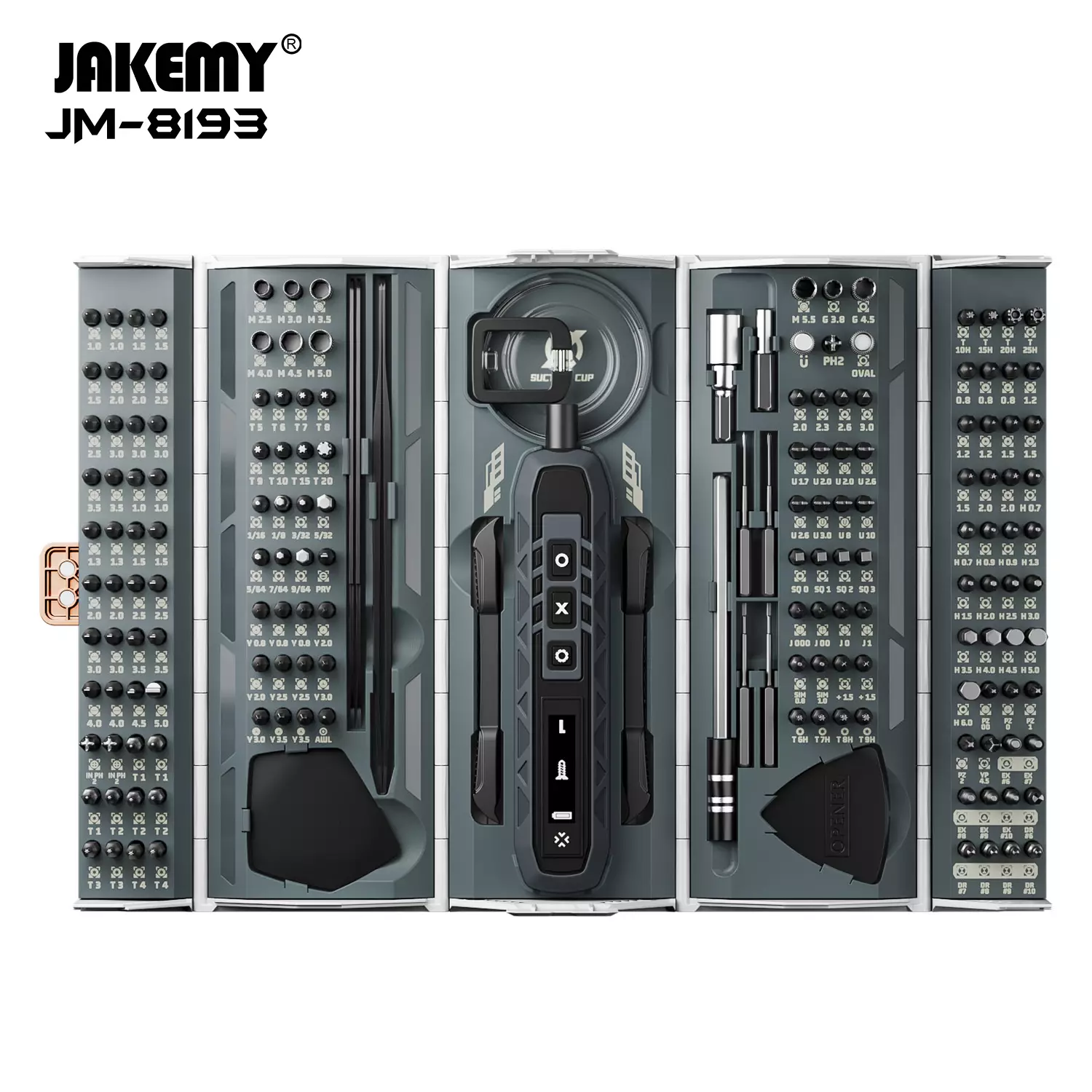
What should you evaluate before choosing a precision screwdriver set?
Start with the devices your customers service. Smartphone repairs, laptop maintenance, camera servicing, and watch repair involve different fastener sizes and access requirements. A suitable precision screwdriver set should provide the bit profiles and sizes needed for these tasks, together with accessories that support disassembly.
Our JM-8193 is a 180-in-1 cordless electric screwdriver set designed for electronics repair, computer maintenance, mobile phone servicing, and other small-device applications. Its configuration includes 144 CR-V precision bits, four longer S-2 bits, 14 sockets, opening tools, tweezers, spudgers, a suction cup, and an extension rod.
For B2B buyers, this broad selection can support customers working across several device categories. Before placing an order, compare the bit inventory against the most common fasteners in your target market. A large set is valuable when its contents match real repair requirements.
Why does adjustable torque matter?
Small electronics often contain delicate screws, plastic housings, and components that can be damaged by excessive force. An electric screwdriver with adjustable torque gives technicians more control over how much rotational force is applied during fastening.
The JM-8193 offers three electric torque settings. Its listed maximum torque values are 0.16 N·m for the first gear, 0.20 N·m for the second, and 0.30 N·m for the third. It also supports manual operation with a maximum torque of 3.0 N·m.
These options let users select a setting according to the fastener and task. However, the highest setting is not automatically the best choice for every screw. Technicians should follow the device manufacturer’s service guidance, begin with an appropriate low setting when necessary, and avoid overtightening small fasteners.
When evaluating a precision screwdriver set, procurement teams should examine the torque range alongside the intended applications. The correct operating range is more important than a general claim of high power.
How should you assess battery performance?
Cordless tools reduce dependence on a power cable, but battery capacity and charging time influence how conveniently they fit into daily work. A repair shop with continuous workloads may need to plan charging schedules, while a mobile technician may prioritize standby performance and easy power monitoring.
The JM-8193 uses a 500 mAh rechargeable battery. Jakemy lists approximately 100–120 minutes of working time and around 100 minutes for charging. The product also features a smart LED battery display, allowing users to check the remaining charge, and an automatic shutdown function after 60 seconds of inactivity.
These specifications help businesses assess whether the tool suits their expected workload. Actual runtime can vary with operating conditions, torque settings, and usage patterns, so buyers should avoid treating a stated duration as a guarantee for every repair session.
Do storage and accessory design affect productivity?
A repair kit needs to keep its components accessible, particularly when multiple technicians share tools. Missing bits, scattered accessories, and inconsistent storage can interrupt work even when the screwdriver itself performs well.
The JM-8193 uses a compact rectangular container measuring 210 × 85 × 82 mm, with a listed single gross weight of 1 kg. Its magnetic storage structure helps organize bits and makes them easier to access and return. The included opening tools, tweezers, and spudgers also support tasks that extend beyond screw removal.
For service managers, an organized case can simplify tool checks between shifts and make missing components easier to identify. We recommend establishing a routine for returning accessories to their designated positions and inspecting bits for wear.
What should distributors check before bulk purchasing?
Product suitability is only one part of a B2B purchasing decision. Buyers also need clear specifications, suitable packaging, sample availability, and a supplier that can communicate requirements before production.
At Jakemy, we support wholesale, OEM, and ODM orders. The JM-8193 has a listed minimum order quantity of 100 pieces, with sample support available. Distributors should confirm current pricing, lead times, packaging details, and customization options before committing to a purchase.
Our broader product range includes manual and electric screwdriver sets for different repair scenarios. This gives distributors opportunities to develop a product assortment based on customer needs rather than offering one configuration for every application. For example, customers who prefer manual control may require a different model from teams handling repetitive disassembly work.
Which model makes sense for your business?
The best tool depends on how frequently customers work with small fasteners, which devices they service, and how much value they place on electric operation. A manual kit may be sufficient for occasional repairs, while an electric model with adjustable torque can suit repetitive work when its operating range matches the application.
We developed the Jakemy JM-8193 to combine cordless operation, three electric torque settings, manual mode, a broad bit selection, and organized storage in one kit. When comparing it with other models, assess torque requirements, bit compatibility, battery performance, and accessory needs together. At Jakemy, we encourage business buyers to select tools around their customers’ actual repair workflows, making specifications and practical suitability the basis of a sound purchasing decision.