
A precision tool kit can look impressive on paper and still be poorly matched to a buyer’s needs. For distributors, repair-tool retailers, and electronics service businesses, the real questions are whether the bit assortment covers common repair jobs, whether technicians can work comfortably with the handle, and whether the kit fits the business’s storage and purchasing requirements. At Jakemy, we design tools for different maintenance scenarios, and our JM-8199 takes a modular manual approach to precision repair. Here is what buyers should evaluate before adding it to their product range.
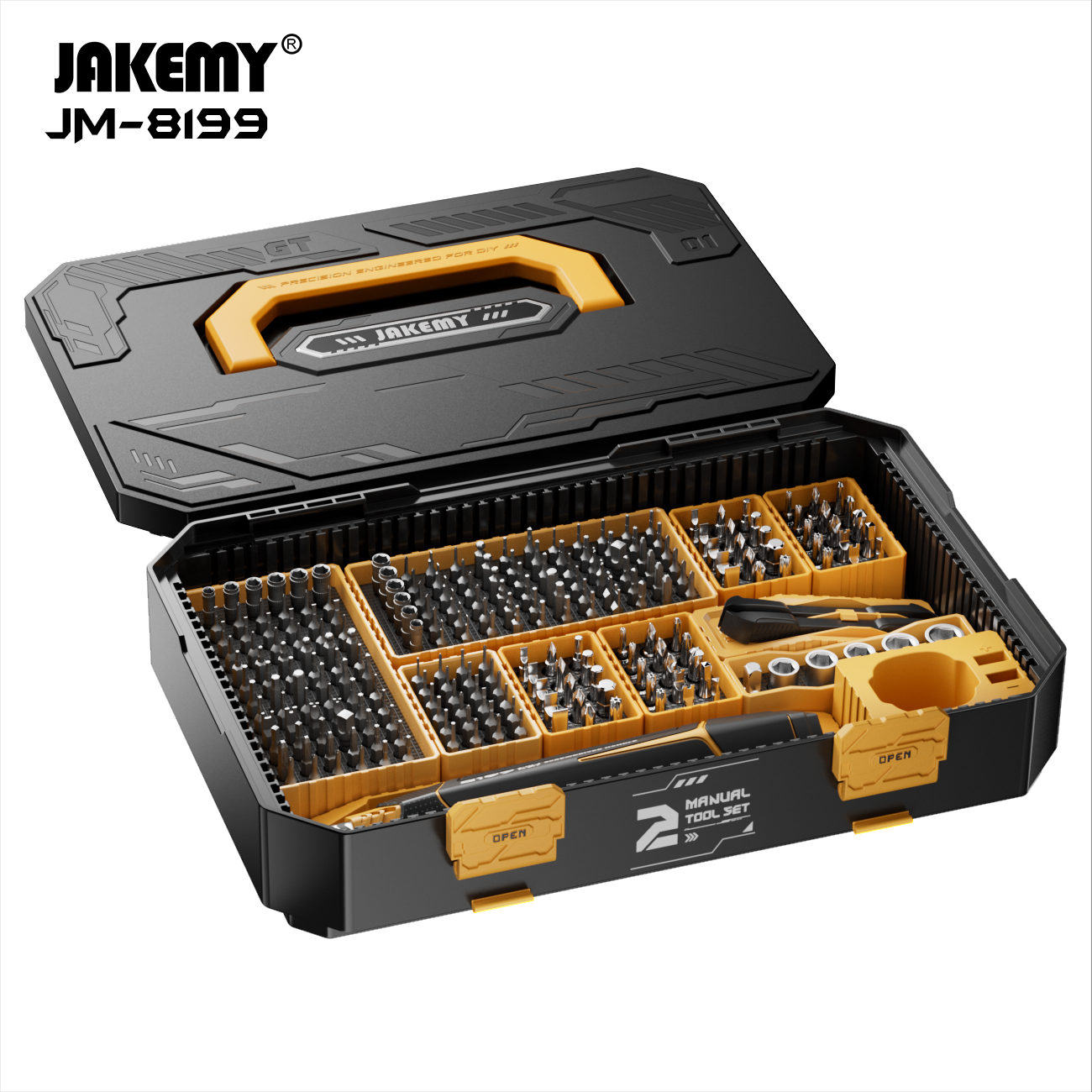
1.Does the Bit Assortment Match Your Customers’ Work?
The JM-8199 is a 257-in-1 manual precision screwdriver set containing 252 bits and a range of supporting components. Its configuration includes 216 CR-V H4.0 × 28 mm bits and 36 CR-V H6.3 × 25 mm bits.
The kit is intended for varied applications, including electronics, laptops, tablets, smartphones, drones, and furniture. However, a large bit count should not be the only selection criterion. Different devices use different fastener profiles and sizes, so buyers should compare the actual bit list with the equipment their customers service most often.
For distributors, this review also helps establish a clear target market. A kit designed for general repair may suit a broader customer base, while specialist workshops may require additional dedicated tools. Reviewing the assortment before ordering helps avoid stocking a product based on quantity alone.
2.Why Does the 2-in-1 Handle Matter?
One of the JM-8199’s defining features is its patented 2-in-1 handle design. The smaller inner handle fits inside the larger outer handle, and the system supports both H4.0 and H6.3 bits.
For technicians, this arrangement offers two handle formats within one kit. Different repair tasks can call for different levels of grip and handling, so having compatible options can be useful when moving between smaller electronic fasteners and other maintenance work.
The compatibility between the two bit sizes is also relevant to purchasing teams. Rather than evaluating only the number of bits, buyers should check whether the handle system supports the included components and whether its configuration fits their intended applications. A well-matched handle and bit system can make a kit more practical across varied tasks.
Before committing to a bulk order, it is worth testing the handle with representative fasteners. Check that bits seat correctly, that the handle feels manageable during repeated use, and that the components can be changed and stored without disrupting the workflow.
3.What Should Buyers Know About Magnetic Tips?
Small screws can be difficult to manage, particularly when technicians work inside confined device housings. The JM-8199 features magnetic screwdriver tips designed to help hold screws during removal and installation.
This feature may be useful for repair businesses that regularly handle small fasteners in laptops, phones, tablets, and other electronics. However, magnetic tips do not replace correct bit selection or careful handling. Users still need to match the profile and size, keep the driver aligned, and avoid applying unnecessary force.
For buyers comparing precision screwdriver kits, magnetic tips are best considered alongside bit material, profile coverage, handle compatibility, and storage. These features work together to determine how well a tool set fits a particular repair workflow.
4.Is a Manual Kit Better Than an Electric Screwdriver?
The right choice depends on how customers work. A manual kit gives technicians direct control over each turn without relying on battery charge. It may suit businesses that prioritize flexible handling, varied fasteners, or a tool that is ready for use without charging.
An electric model can be more suitable when repetitive fastening is a major part of the workflow. For example, the Jakemy JM-8193 is a 180-in-1 cordless electric screwdriver set with three electric torque settings, manual operation, and a smart LED battery display. Its powered operation offers a different approach from the JM-8199’s manual design.
These models should not be treated as interchangeable simply because both support precision repair. The JM-8199 emphasizes a broad manual bit assortment and dual-handle configuration, while the JM-8193 combines powered operation with torque adjustment and battery management. Buyers should consider repair volume, required control, charging routines, and the devices being serviced before deciding which type belongs in their catalog.
5.Can the Kit Support Your Storage and Distribution Needs?
The JM-8199 measures 300 × 210 × 60 mm and has a listed single gross weight of 1.782 kg. These figures help purchasing teams estimate storage, shipping, and retail-display requirements.
Its modular toolbox layout is relevant to businesses that want tools and accessories organized together. Buyers should inspect the physical arrangement during sample evaluation, checking whether components are easy to identify and return to their designated positions. This can be especially useful for repair teams sharing tools across shifts.
For wholesalers and private-label brands, procurement also involves commercial details. Jakemy lists a minimum order quantity of 100 pieces, with sample support and OEM/ODM customization available. The JM-8199 product page describes options such as logo and label customization, as well as adjustments to modular components for qualifying bulk orders. Confirm the current scope, pricing, packaging, and lead times with our team before placing an order.
Make the Decision Around Your Market
The Jakemy JM-8199 is worth considering when your customers need a manual precision toolkit with a broad bit assortment, magnetic tips, and a dual-handle system compatible with H4.0 and H6.3 bits. Its value depends on how closely those features match the fasteners and working conditions encountered in your target market.
At Jakemy, we encourage B2B buyers to evaluate the full configuration, test samples where practical, and confirm procurement terms before scaling an order. Compare manual and electric options based on actual workflow requirements, not just the total number of components. That approach helps you choose a tool kit that is easier to position, explain, and supply to the right customers.