
A repair toolkit is useful only when its contents match the work on the bench. A phone repair counter, an IT maintenance team, and a tool distributor may all need precision drivers, but not the same bit range or accessories. At Jakemy, we design tools for practical electronics maintenance, and we encourage buyers to assess the job first—not simply choose the set with the largest piece count.
 Start with the devices and fasteners you handle
Before comparing an electronics screwdriver set, list the devices your technicians work on most often. Smartphones and tablets may use Phillips, Torx, hex, or pentalobe fasteners; computers and cameras can call for other sizes and profiles. Check repair documentation and the fasteners you encounter rather than assuming one kit covers every model.
Bit fit matters as much as variety. A tip that is too large, too small, or poorly matched can slip, damage the screw recess, or slow disassembly. Choose a set that identifies its bit types and sizes clearly, and replace worn bits instead of forcing them to grip. For teams supporting multiple device categories, common profiles are often more useful than rarely used pieces.
Is a 47 in 1 screwdriver set enough for daily repair?
Piece count is a starting point, not a performance rating. A 47 in 1 screwdriver set can suit routine small-device repairs when staff need a compact kit with drivers and opening accessories. A larger set may be better for a workshop handling more product types or specialized fasteners. The right choice depends on your repair mix, how often tools travel, and whether technicians can access extra tools when an uncommon screw appears.
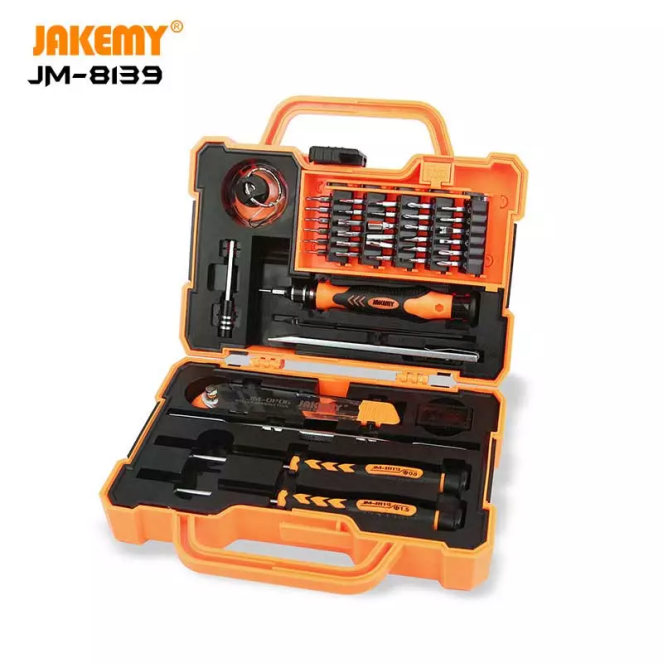
Our JM-8139 is a 47-in-1 precision electronics repair kit for mobile phone, computer, tablet, camera, watch, and other small-device maintenance. Its listed bits include Torx, hex, slotted, Phillips, tri-wing, U-shaped, pentalobe, and triangle profiles. This range supports many common tasks, but buyers should compare the included sizes with the devices they service.
Look beyond the bits to the full repair workflow
Opening a device can require more than loosening screws. Adhesive-backed screens, tight covers, and SIM trays call for suitable tools and careful handling. The JM-8139 combines precision bits with a roller opening tool, metal opening stick, plastic opening tool, suction cup, curved-tip tweezers, extension bar, utility knife, and SIM eject pin. A suction cup can help lift a compatible smooth panel, while a plastic pry tool can help separate a seam with less risk of scratching than an unsuitable metal tool. Follow device service instructions and choose tools appropriate for the material.
An extension bar can improve access to recessed screws, while curved-tip tweezers help position small screws or components. Having these accessories in one kit can reduce interruptions caused by searching for separate tools.
Check materials, grip, and screw control
The driver tip needs to maintain its shape and engage the screw properly. The JM-8139 uses CR-V (chromium-vanadium) bits. Material alone does not guarantee performance: bit selection, manufacturing quality, wear, and hand pressure also matter. Avoid using precision bits as pry bars or applying excessive torque to small fasteners.
The set features an anti-slip TPR handle and magnetic tips. A secure grip helps technicians control rotation, while magnetism can make small screws easier to pick up and guide into position. Magnetic tips are a convenience, not a substitute for careful handling; follow device-specific guidance when working near sensitive parts.
Make storage part of the buying decision
A complete kit can still waste time if it is difficult to organize. Check whether each accessory has a designated position, whether the case fits the workbench or field-service bag, and whether staff can spot missing tools. The JM-8139 comes in a black-and-orange toolbox measuring 220 × 175 × 60 mm, with an individual gross weight listed as 0.720 kg. These details help mobile technicians assess storage needs before ordering.
For shared kits, return each item to its slot after use, inspect tips regularly, and separate damaged tools from serviceable stock. This makes equipment easier to manage across shifts.
Evaluate the supplier as well as the product
For B2B buyers, suitability is only one part of procurement. Consistent supply, clear product information, customization, and responsive communication matter when stocking a repair chain or supplying other businesses. At Jakemy, we operate our own manufacturing facilities and produce our branded tools in-house. Our factory uses multiple production lines and precision equipment, and we provide OEM/ODM services for buyers with suitable customization needs.
Our warehousing service can support storage for up to 60 days, with capacity for up to 8 million sets. This may help distributors coordinate inventory and order schedules, although availability, lead times, and customization requirements should be confirmed for each order. When evaluating suppliers, ask about configuration, packaging, quality checks, order quantities, and documentation for your market.
Match the set to the work—not just the headline number
Choose a compact precision kit when your workload centers on common electronics repairs and portability matters. Consider a broader set when technicians routinely encounter more fastener types or need specialized accessories. Compare the exact bit list, handling features, storage design, and supplier support before deciding.
We developed the Jakemy JM-8139 to bring frequently used precision bits and practical opening tools together in one organized kit. If your business supplies repair technicians, electronics service teams, or maintenance retailers, use your typical repair list to check whether this electronics screwdriver set fits your requirements. A clear match between tool configuration and real work is a more useful buying standard than piece count alone.