
In a model-making workshop, a cutting tool needs a designated place between tasks. Leaving an ultrasonic cutter loose on a crowded workbench can make tool handling less organized and increase the chance of accidental contact with its blade. For distributors, professional tool brands, and workshop equipment suppliers, choosing the right storage accessory involves more than comparing prices. At Jakemy, we develop accessories around specific tools and practical workspace requirements, helping business buyers evaluate compatibility, usability, and supply options together.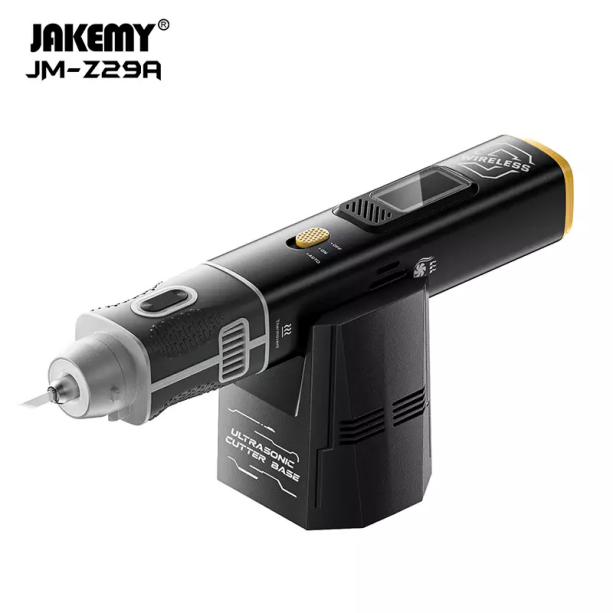
Why does an ultrasonic cutter storage base matter?
An ultrasonic cutter storage base provides a designated position for a compatible cutter when it is not being used. In workshops that alternate between cutting, grinding, polishing, and assembling components, a consistent storage location can help keep the work surface organized and make tools easier to locate.
However, a storage base should not be selected by appearance alone. Buyers need to consider the cutter model, the way the tool sits in the holder, the available bench space, and how frequently operators pick up and return the tool. A base designed for one model may not fit another correctly, even when the products look similar.
We developed our JM-Z29A and JM-Z29B dual-mode storage bases for specific Jakemy ultrasonic cutters. Both support two placement methods, allowing buyers to consider different workspace arrangements while keeping model compatibility central to the purchasing decision.
How should buyers check model compatibility?
Compatibility should be the first checkpoint when comparing suppliers. A holder that is too loose may not position the cutter as intended, while an incompatible opening or support structure can make the accessory impractical for daily use.
Our JM-Z29A is designed to fit the JM-Y09, while the JM-Z29B is intended for the JM-Y10 and JM-Y10 Pro. These model-specific distinctions matter when distributors manage several ultrasonic cutter products or assemble complete tool packages for different customer segments.
Before placing a bulk order, compare the supplier’s compatibility list with the exact cutter models in your catalog. If you plan to bundle a base with a cutter, confirm the model pairing in the purchase documentation and product packaging. For custom projects, request confirmation before assuming that a revised cutter design will fit an existing accessory.
At Jakemy, we support inquiries about purchasing these bases alongside our ultrasonic cutters, as well as customization of individual components within a set. This gives business buyers a practical route to discuss configurations rather than relying on visual similarity alone.
Why are placement options and stability important?
Workbenches differ considerably. A compact model-making station may prioritize space efficiency, while a shared production bench may need a clearly defined location for frequently used tools. A base with more than one placement option gives buyers greater flexibility when planning the workspace.
The JM-Z29A/Z29B series supports both vertical stand placement and horizontal lay placement. This dual-mode design lets users consider how the accessory will fit their working environment. Before selecting a configuration, assess the surrounding equipment, the operator’s normal workflow, and whether the chosen position leaves enough room for other tools.
Stability deserves equal attention. Our product range lists a weighted base and a non-slip bottom pad for this series. These features are intended to support more stable placement, but the actual setup still matters. Buyers should use a suitable, level surface and follow the cutter manufacturer’s instructions for safe storage. A holder should not be treated as a replacement for a blade cover or other required safety measures.
What should you evaluate beyond the holder itself?
A storage accessory becomes more useful when it fits into a complete equipment plan. For example, model-making businesses may also need cutting mats, replacement blades, polishing accessories, and tools for finishing 3D-printed components. Purchasing related items together can simplify product selection and reduce the number of separate configurations a distributor needs to manage.
When evaluating ultrasonic cutter containers and holders, distinguish between accessories that store a tool and products designed to organize blades, spare parts, or other workshop supplies. These products serve different purposes, so the supplier should clearly explain what each item accommodates.
We offer a broader ultrasonic cutter range, including the JM-Y09 and JM-Y10/JM-Y10 Pro, together with related accessories. Buyers can use this product ecosystem to assess whether a base fits an existing catalog or could become part of a bundled offering. The right combination depends on customer demand, the materials being processed, and the other tools required for the application.
How can B2B buyers assess a supplier?
Product suitability is only one part of a purchasing decision. Distributors and tool brands also need clear specifications, dependable communication, consistent production, and customization options that fit their sales strategy.
At Jakemy, we operate our own manufacturing facilities and have experience supplying tools and accessories to business customers. Our manufacturing setup includes six production lines and more than 20 high-precision machines, supporting our work across precision screwdrivers, ultrasonic cutters, and related products.
For the JM-Z29A/Z29B, our product category lists a minimum order quantity of 100 pieces and sample support. We also offer OEM and ODM customization. Buyers considering private-label products should discuss logo requirements, packaging, order quantities, sample approval, and production lead times before confirming a purchase. These details help establish whether a supplier can support the intended product range and sales channel.
It is also worth asking how the supplier handles product revisions and compatibility updates. Since accessory fit depends on the corresponding tool design, clear communication about model changes can help reduce ordering errors and avoid confusion in downstream distribution.
Make the purchasing decision around your customers
The best supplier is not necessarily the one offering the lowest initial price or the widest accessory catalog. A better assessment considers model compatibility, placement options, stability features, customization, and the supplier’s ability to support repeat orders.
Our JM-Z29A and JM-Z29B are designed for different Jakemy ultrasonic cutter models and offer two ways to position the tool between tasks. For distributors, workshop equipment suppliers, and brands building an ultrasonic cutting product range, we recommend confirming the required model first, then reviewing sample availability and customization needs.
At Jakemy, we aim to help business partners select accessories that make sense for their existing products and customers. By evaluating the actual workflow alongside supplier capabilities, you can choose an ultrasonic cutter storage base that fits your product range instead of purchasing an accessory based on appearance alone.