
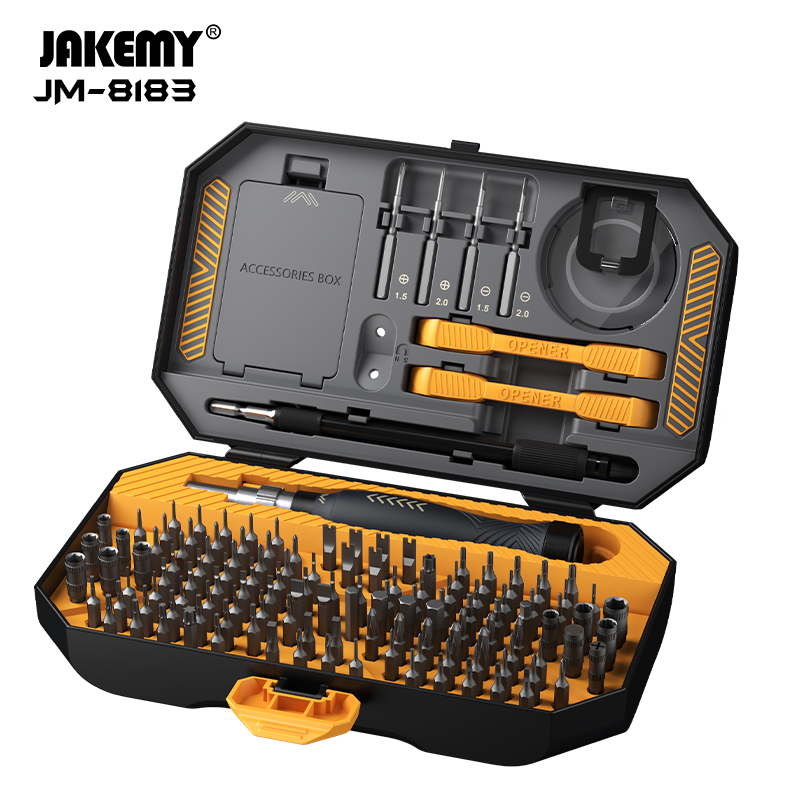
Choosing an electronics repair kit is not simply a matter of selecting the box with the most components. Repair technicians need the right bit profiles, convenient access to recessed fasteners, and accessories that support safe device disassembly. For distributors and repair businesses, the kit must also fit the needs of the intended customer group and make commercial sense to stock. At Jakemy, we designed the JM-8183 as a 145-in-1 precision screwdriver set with accessories for a range of electronics maintenance tasks. Here is how to assess whether it belongs in your repair workflow or product portfolio.
1.Start With the Devices You Need to Repair
Before choosing a tool kit, identify the equipment your technicians or customers handle most often. Smartphones, laptops, tablets, game consoles, desktop computers, and small household appliances can use different screw profiles and sizes. A set with a broad assortment is useful only when its contents match those fasteners.
The JM-8183 contains 132 screwdriver bits, with 116 CR-V steel bits and four specialized 45 mm deep-hole bits made from S-2 chromium-molybdenum steel. Its listed profiles include Phillips, slotted, Torx, security Torx, hex, tri-wing, pentalobe, triangle, and other types.
This variety makes the kit worth evaluating for general electronics repair. However, check the complete bit list against the devices you service rather than assuming that every screw type is covered. If your business specializes in one device category, confirm the required sizes before purchasing.
2.Look Beyond the Total Piece Count
The phrase “145-in-1” describes the overall kit configuration, but it does not tell you how useful every component will be for your work. When comparing a Jakemy screwdriver set with alternatives, review the actual bit assortment, materials, and supporting accessories.
When evaluating the JM-8183 for wholesale purchasing, compare its bit configuration with the fasteners commonly encountered in your customers’ repair work. Check whether the included profiles and sizes cover their main applications, and identify any gaps that may require additional tools. This helps distributors assess product suitability, avoid unnecessary overlap with existing inventory, and build a more targeted electronics repair tool range. The correct choice still depends on the screw, the device, and the condition of the tool.
For technicians, a useful selection process starts with identifying a fastener, checking the bit profile and size, and ensuring the tip fits securely before applying force. For distributors, a detailed component list also helps create accurate product descriptions and answer customer questions without overstating compatibility.
3.Consider Access to Recessed Screws
Some screws sit inside narrow openings or deeper structures where a standard bit may be difficult to position. The JM-8183 includes four 45 mm deep-hole bits and a handle with a built-in adjustable extension that can extend up to 50 mm. A separate 130 mm extension bar is also included.
These features offer different ways to reach fasteners, depending on the working space. Before using an extension, make sure the selected bit can reach the screw directly and remain aligned with its axis. Avoid applying sideways pressure or forcing a tool into an opening that does not provide sufficient clearance.
For repair businesses handling several device types, this flexibility can be a practical consideration. Buyers should nevertheless verify that the specific fasteners encountered in their repair work are compatible with the included bits and accessories.
4.Check Whether the Accessories Support Your Workflow
Electronics repair often involves more than removing screws. Technicians may also need to separate a housing, lift a suitable panel, or handle small components. The JM-8183 includes a suction cup, two spudgers, five ultra-thin opening tools, tweezers, and an extension bar.
These accessories support different tasks during disassembly. A suction cup may help lift compatible smooth surfaces, while opening tools can assist with separating suitable housings. Tweezers can help handle small parts, and spudgers can support controlled prying or positioning when appropriate.
The presence of these tools does not guarantee that every device can be opened safely with the same method. Repair procedures, materials, adhesives, and cable placement vary. Buyers should consider whether the accessories fit their customers’ typical work and whether additional specialist tools may still be necessary.
5.Evaluate Storage, Portability, and Organization
A repair kit needs to be manageable during everyday use. If bits are difficult to identify or accessories are frequently misplaced, a large assortment can become less convenient than expected.
The JM-8183 measures 184 × 106 × 45 mm, with a listed single gross weight of 0.7014 kg. Its case uses a diamond-cut texture, and the components are arranged in designated positions. The product page also describes laser-engraved bit markings, which help users identify sizes without relying on labels that may wear away.
For a repair technician, clear organization can simplify tool selection and make it easier to return components after a job. For a wholesaler or retailer, the compact case dimensions and product weight provide useful information for storage, shipping, and shelf planning.
6.What Should B2B Buyers Confirm Before Ordering?
Repair businesses and distributors should assess product suitability alongside supply requirements. The JM-8183’s official listing specifies a minimum order quantity of 100 pieces and indicates OEM/ODM service. These options may be relevant to businesses building a repair-tool range or discussing customized branding.
Before confirming an order, ask about sample availability, current lead times, packaging, customization scope, and the final agreed product configuration. Reviewing a sample can help your team evaluate the handle, bit organization, and accessory selection before committing to a larger quantity.
At Jakemy, we recommend matching the tool kit to a defined customer group rather than choosing solely on price or component count. This makes product positioning more accurate and helps your sales team explain where the kit fits—and where another tool may be needed.
Choosing a Kit That Fits the Job
The JM-8183 combines a broad selection of precision bits, deep-hole options, an adjustable handle extension, and accessories for electronics disassembly. It is worth considering for repair businesses and distributors whose customers need a versatile manual kit for multiple device categories.
At Jakemy, we believe a well-informed purchasing decision begins with actual repair requirements. Compare the bit list, check access needs, evaluate the accessories, and confirm commercial terms before ordering. When a Jakemy tool kit matches the fasteners and workflows your customers encounter, it becomes easier to recommend the product accurately and build a tool range around real maintenance needs.