
For distributors, wholesalers, and electronics repair-tool suppliers, selecting a precision screwdriver set is a product portfolio decision as much as a technical one. The right configuration should match the repair tasks common among target customers, offer a clear value proposition within the existing product range, and meet practical requirements for stocking and resale. At Jakemy, we recommend assessing bit coverage, accessory configuration, storage, and supplier support before comparing headline piece counts. The JM-8139 provides a useful reference for evaluating these factors when sourcing tools for electronics repair markets.
1.Which Screwdriver Bits Should an Electronics Repair Set Include?
The first step is to identify the devices your customers repair most frequently. Smartphones, computers, tablets, cameras, watches, and other compact electronics can use different screw profiles and sizes. A set with many bits may still be unsuitable if it lacks the profiles commonly required for your target market.
Look for a selection that covers practical repair tasks. Common profiles include Phillips, slotted, Torx, hex, tri-wing, U-shaped, pentalobe, and triangle bits. The appropriate combination depends on the devices being serviced, so compare the actual bit list instead of relying only on the total quantity.
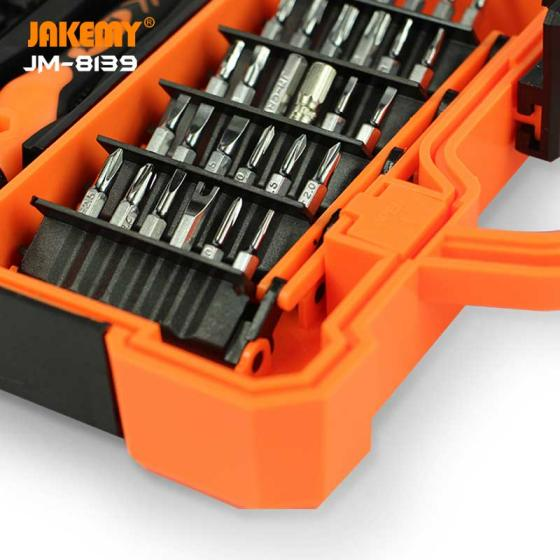
Our Jakemy JM-8139 is a 47-in-1 precision electronics screwdriver set featuring CR-V bits in multiple profiles and sizes. Its listed configuration includes Torx, hex, slotted, Phillips, tri-wing, U-shaped, pentalobe, and triangle options. This range makes it worth considering for suppliers serving general electronics repair rather than a single specialized device category.
2.Why Do Bit Material and Handle Design Matter?
Bit selection is only part of the evaluation. Material, fit, and handling influence how easily technicians can control a screwdriver during repeated work. Poor bit fit can cause slipping, potentially damaging screw heads or surrounding components. Buyers should therefore consider whether the set provides clearly identified sizes and a selection suited to small fasteners.
The JM-8139 uses CR-V precision bits. When assessing any kit, check the stated material specifications and whether the available profiles match the requirements of your intended users. Do not assume that every bit material performs identically across all applications.
Handle design is equally important. Electronics repair often involves small screws in confined spaces, where controlled movement matters more than applying excessive force. The JM-8139 features a non-slip TPR handle and magnetic tips. The handle supports a steadier grip, while magnetic tips help retain small screws during removal and installation. These details can make a compact set more practical for technicians who perform repeated disassembly tasks.
3.Are Opening Tools Necessary for Electronics Repair?
A screwdriver set may loosen fasteners effectively but still leave technicians without the tools needed to open a device. Screens, covers, and tightly fitted housings can require separate opening tools. A more complete kit can reduce the need to gather individual accessories from different storage locations.
When comparing options, consider whether the package includes tools for lifting, separating, gripping, and reaching components. The JM-8139 combines its screwdriver components with a roller opening tool, metal opening stick, plastic opening tool, suction cup, curved-tip tweezers, extension bar, utility knife, and SIM eject pin.
Each accessory has a distinct purpose. A suction cup can help lift suitable screens or smooth covers; plastic opening tools can assist with separating housings; and tweezers can help handle small components. An extension bar can improve access to recessed screws. These tools do not eliminate the need for proper repair procedures, but they make the kit more versatile across different disassembly stages.
For buyers comparing a Jakemy tool set with simpler screwdriver-only products, this difference in accessory configuration is important. Evaluate the tools included, their intended functions, and whether the package suits your customers’ typical repair workflows.
4.How Should You Evaluate Storage and Portability?
Storage is easy to overlook when comparing technical specifications. In a repair shop, poorly organized bits can slow down work, increase the chance of losing small components, and make stock management more difficult. For distributors, packaging dimensions and product weight can also affect warehousing, shipping, and shelf presentation.
The JM-8139 comes in a compact toolbox measuring 220 × 175 × 60 mm, with designated positions for the bits and accessories. Its listed single gross weight is 0.720 kg. These specifications give purchasing teams concrete information for estimating storage requirements and planning product displays.
Before placing an order, consider the working environment. A mobile repair technician may prioritize portability, while a workshop may place greater value on clear organization and a broad accessory selection. Neither requirement automatically makes one configuration better for every buyer; the intended use should guide the decision.
5.What Should B2B Buyers Check Before Ordering?
For wholesalers, repair-tool distributors, e-commerce sellers, and private-label businesses, product suitability is only one part of procurement. Buyers should also review supplier support, packaging, customization options, and the consistency between product listings and delivered configurations.
We offer OEM and ODM services for the JM-8139. This gives business customers an opportunity to discuss requirements such as branding and product presentation with our team. Before confirming an order, clarify the current minimum order quantity, sample availability, packaging details, lead time, and any customization requirements directly with the supplier. Confirm that the agreed specification matches the final quotation and order documentation.
It is also useful to assess the product against your existing range. A compact manual kit may complement more extensive repair toolboxes by serving customers who need a practical selection of bits and opening accessories without a larger collection. Reviewing the target customer, sales channel, and competing configurations can help you position the product more clearly.
Choose for the Repair Tasks, Not Just the Tool Count
A suitable precision screwdriver set should combine the right bit profiles, reliable handling, useful opening accessories, and storage that fits the working environment. For B2B buyers, those practical details should be considered alongside supply terms and customization support.
The Jakemy JM-8139 brings these elements together in a 47-in-1 configuration for common electronics repair tasks. If you are comparing a Jakemy product with other kits for your distribution or repair business, start by matching its listed components to your customers’ needs, then verify the current commercial terms with our team. That approach makes it easier to select a product based on real use cases rather than tool count alone.