
An ultrasonic cutter is only one part of an efficient cutting workstation. When the tool is not in use, operators still need a designated place to set it down, keep the work surface organized, and prepare for the next task. For manufacturers, model-making workshops, tool distributors, and businesses supplying precision cutting equipment, a suitable storage base is a small accessory with practical implications for daily workflow.
At Jakemy, we develop ultrasonic cutters and compatible accessories for different working environments. We approach accessory selection as part of a complete tool setup rather than an isolated purchase. When evaluating an ultrasonic cutter storage base, buyers should consider compatibility, placement options, stability, workspace requirements, and procurement flexibility.
1.Is the Storage Base Compatible with Your Ultrasonic Cutter?
Compatibility should be the first checkpoint. Ultrasonic cutters can differ in handle dimensions, blade-holder designs, and accessory interfaces. A base intended for one model may not securely accommodate another, even when both tools perform similar cutting tasks.
Before purchasing, compare the base’s specified compatible models with the equipment already used by your team. This is especially important for distributors supplying several cutter models or workshops standardizing tools across multiple workstations. Checking compatibility before ordering can help prevent mismatched accessories and unnecessary replacement purchases.
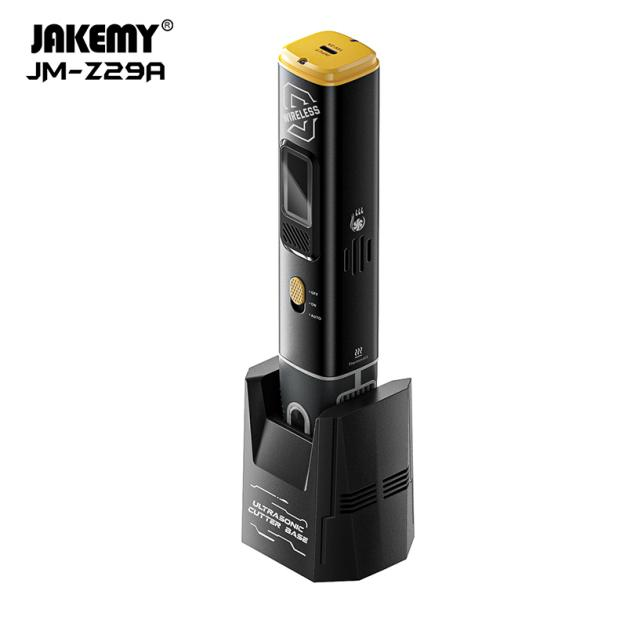
Our Jakemy JM-Z29A/Z29B series addresses this requirement with two model-specific options. The JM-Z29A is designed to fit the JM-Y09, while the JM-Z29B matches the JM-Y10 and JM-Y10 Pro. Buyers can therefore select the appropriate version according to their existing cutter inventory instead of treating the two bases as interchangeable.
For bulk orders, we recommend confirming the exact cutter model and accessory configuration with our team. If a customer is purchasing a new cutter and its accessories together, checking the complete combination in advance can simplify product selection and inventory planning.
2.Does an ultrasonic cutter holding base Offer Flexible Placement?
Workstations do not all have the same layout. A product development bench may have limited surface space, while a model-making station may need frequent access to cutting tools, materials, and small components. The way an accessory can be positioned therefore matters.
A dual-mode design gives users more flexibility than a base with only one placement option. Depending on the intended setup, vertical standing can provide a dedicated storage position, while horizontal placement may suit a different arrangement of tools and materials. Buyers should check how the base is designed to support the cutter in each position rather than assuming that every stand offers the same functionality.
Our JM-Z29A/Z29B storage base features two storage modes, allowing users to choose between vertical standing and horizontal placement. This provides an additional way to organize the workstation around the cutting tasks being performed.
For businesses outfitting several stations, it is worth considering whether operators share tools or keep individual cutters at their own benches. A suitable ultrasonic cutter holding base should fit the team’s actual working pattern, making tool placement predictable without occupying more space than necessary.
3.How Important Are Base Stability and Surface Grip?
An accessory should support orderly tool placement rather than introduce another source of movement on the workbench. Base weight and contact with the supporting surface are therefore important selection criteria.
A lightweight base may be easy to transport, but buyers should also consider how it behaves when a tool is placed into or removed from its holder. A weighted construction can help provide a more substantial foundation, while a non-slip bottom pad helps reduce unwanted movement on a suitable work surface.
Our JM-Z29A/Z29B uses a weighted base with a non-slip bottom pad. These features are relevant to workshops where tools are repeatedly picked up and returned throughout the working day.
However, stability depends on the complete setup, including the bench surface, the condition of the pad, and correct placement of the cutter. A storage base is not a substitute for safe operating procedures. Operators should follow the cutter manufacturer’s instructions, keep the blade protected when required, and avoid placing the tool where it could be knocked off the workstation.
4.Will the Base Fit Your Workspace and Workflow?
Storage accessories are most useful when they fit naturally into the working environment. A crowded bench can make tools harder to locate, restrict access to materials, and complicate routine cleanup. Before selecting a base, buyers should review available space and consider how operators move between cutting, inspection, assembly, and storage tasks.
For example, a prototyping team may need a clear area around its cutting equipment to handle samples and test different materials. A production support area may prioritize consistent tool placement so that equipment can be returned to a known location between tasks. Distributors may instead focus on packaging dimensions, shelf organization, and how the accessory fits into a broader product offering.
We recommend assessing the complete workstation rather than judging a base by appearance alone. Consider where the cutter will be stored, whether the selected placement mode fits the available surface, and how operators will access the tool without disturbing nearby equipment.
The JM-Z29A/Z29B provides two placement options, giving buyers flexibility when planning these arrangements. Its suitability will still depend on the cutter model and the space available at each workstation.
5.What Should B2B Buyers Check Before Placing an Order?
For distributors, tool brands, and commercial buyers, accessory selection involves more than technical fit. Minimum order quantities, sample availability, customization, and coordination with related products can all affect purchasing decisions.
At Jakemy, we offer the JM-Z29A/Z29B for purchase alongside our ultrasonic cutters, and we support customization of individual parts within a set. OEM and ODM services are also available. This gives business customers an option to evaluate the base as part of a complete cutter package or discuss whether a customized configuration suits their product range.
Our related-accessories listing specifies a minimum order quantity of 100 pieces and sample support. Buyers should confirm current availability, customization scope, packaging, and delivery schedules with us before committing to a larger order.
It is also useful to review demand by compatible model. A distributor serving customers who use the JM-Y09 may need a different inventory mix from one supplying JM-Y10 or JM-Y10 Pro users. Matching the base version to the cutter models customers actually purchase helps reduce avoidable stock mismatches.
Building a More Organized Cutting Setup with Jakemy
A storage base may be a small part of a precision cutting system, but the right choice depends on several connected considerations: model compatibility, placement flexibility, stability, workspace layout, and purchasing requirements.
At Jakemy, we develop ultrasonic cutters and related accessories with practical tool organization and business supply needs in mind. Our JM-Z29A/Z29B dual-mode storage base gives buyers two model-specific options and supports vertical or horizontal placement. If you are sourcing an ultrasonic cutter storage base for a workshop, product bundle, or distribution business, review the compatible model first, then discuss samples and customization with our team to determine the most suitable configuration for your requirements.