
Precision processing has become increasingly important across industries such as model manufacturing, electronics, prototyping, product development, and creative fabrication. We recognize that professionals require tools capable of delivering consistent results while handling a variety of materials and finishing requirements. An ultrasonic cutter designed for multiple precision operations can improve workflow efficiency by combining cutting, surface refinement, and detailed finishing into a single solution. Understanding the characteristics of this technology helps buyers evaluate equipment that supports demanding production and workshop applications.
Why Ultrasonic Technology Delivers Superior Precision
Unlike conventional cutting methods that rely primarily on mechanical force, ultrasonic technology generates high-frequency vibration to assist material processing. This operating principle allows users to perform delicate work with greater control while minimizing unnecessary stress on the workpiece.
For applications involving intricate contours, narrow openings, or complex geometries, ultrasonic tools can produce smoother cutting paths and cleaner finished edges. They are particularly suitable for tasks requiring careful attention to detail, such as prototype fabrication, handcrafted models, electronic assemblies, and precision component modification.
Another advantage is versatility. Rather than serving only as a cutting tool, ultrasonic technology supports additional finishing processes, allowing operators to complete multiple stages of material preparation using the same equipment. This integrated approach can simplify workflows and improve operational efficiency in professional environments.
Key Factors Buyers Should Evaluate Before Choosing an Ultrasonic Cutter
Selecting an ultrasonic cutter involves more than comparing basic specifications. We recommend examining several practical factors that directly influence productivity and long-term usability.
Operating frequency is one important consideration because stable ultrasonic performance contributes to consistent processing quality across different materials. Buyers should also evaluate the available operating functions to determine whether the equipment supports not only precision cutting but also surface grinding and polishing for diverse project requirements.
User experience is another valuable factor. Features such as intuitive controls, clear operating information, comfortable grip design, and effective heat management help improve efficiency during extended working sessions. Convenient maintenance, accessible blade replacement, and compatibility with multiple blade types can further reduce downtime while increasing application flexibility.
Safety features should not be overlooked. Protective mechanisms, operating status monitoring, and practical accessory management all contribute to a safer and more organized working environment, particularly for businesses that use precision tools on a regular basis.
Applications Across Professional Industries
Modern ultrasonic cutters have expanded well beyond hobby-related applications. Their ability to process multiple materials makes them useful across a broad range of professional industries.
Product designers frequently use ultrasonic tools when creating prototypes that require accurate trimming and detailed finishing. Electronics manufacturers benefit from precise material processing during circuit board modification and component preparation. Industrial workshops often rely on ultrasonic equipment when working with composite materials, engineering plastics, acrylic, wood, leather, and specialized fabrication materials.
Educational institutions, research laboratories, and technical training centers may also incorporate ultrasonic tools into practical learning environments where precision processing techniques are demonstrated. By supporting multiple material types and several finishing operations, ultrasonic technology provides businesses with greater flexibility when responding to changing production requirements.
A Practical Choice for Professional Precision Processing
Choosing professional equipment involves balancing precision, versatility, operating convenience, and long-term reliability. We believe that ultrasonic technology offers an efficient solution for businesses seeking greater accuracy across a wide range of material processing applications.
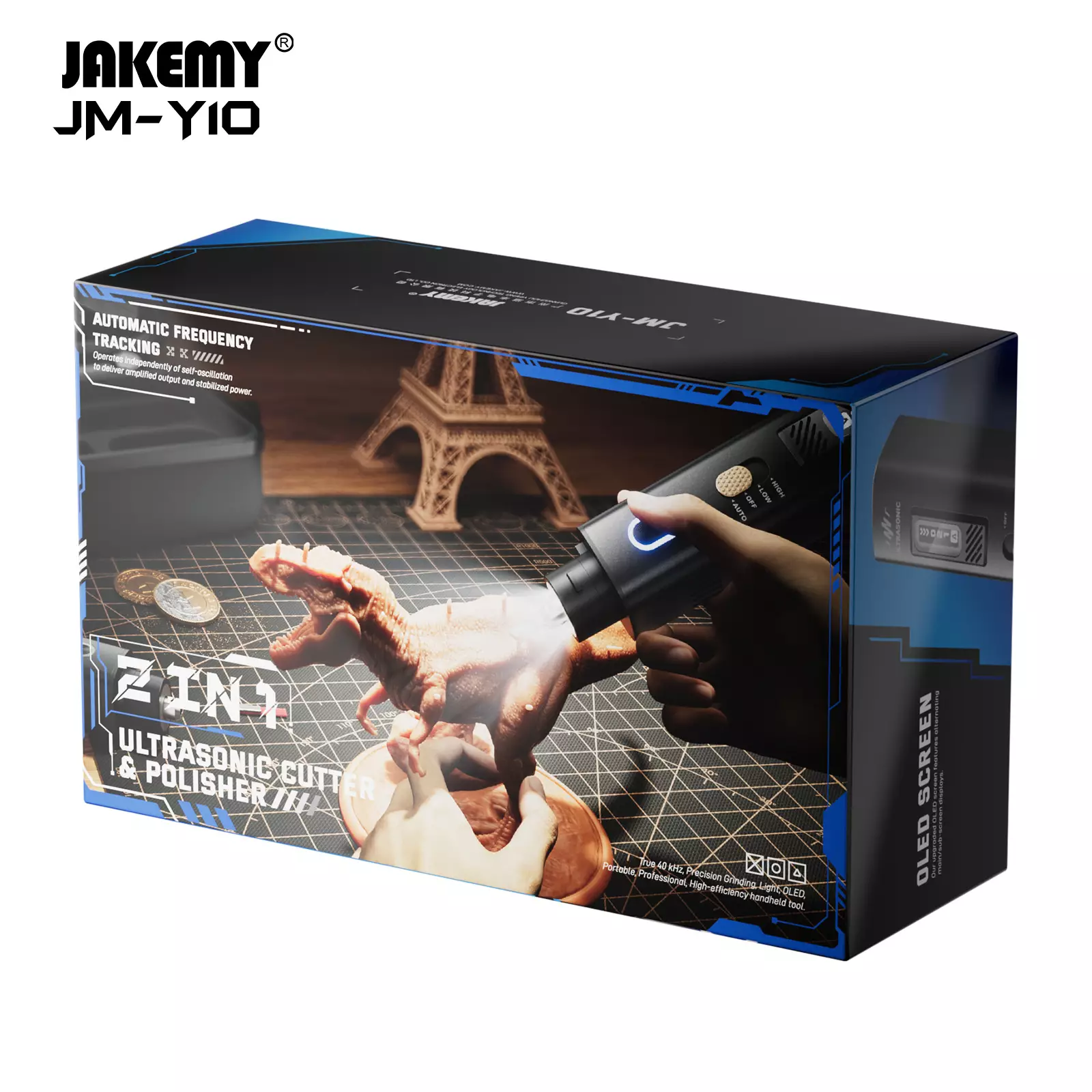
At Jakemy, we continuously develop practical precision tools designed for professional users and technical applications. Our JM-Y10 Pro ultrasonic cutter features a powerful 35W ultrasonic system with dual-core PZT ceramics and a titanium alloy transducer operating at a true 40kHz frequency for cutting, grinding, and polishing. It supports multiple materials, including carbon fiber, acrylic, leather, metals, wood, 3D-printed resins, and PCBs. The ergonomic aluminum alloy handle, dynamic cooling system, OLED dual-display, sound reminders, proprietary blade system with additional Pro blades, child safety lock, Type-C 35W fast charging, blade storage, and integrated LED lighting are designed to enhance usability and convenience. By focusing on practical innovation and dependable product development, Jakemy aims to provide precision tool solutions that support the evolving needs of professional customers.