
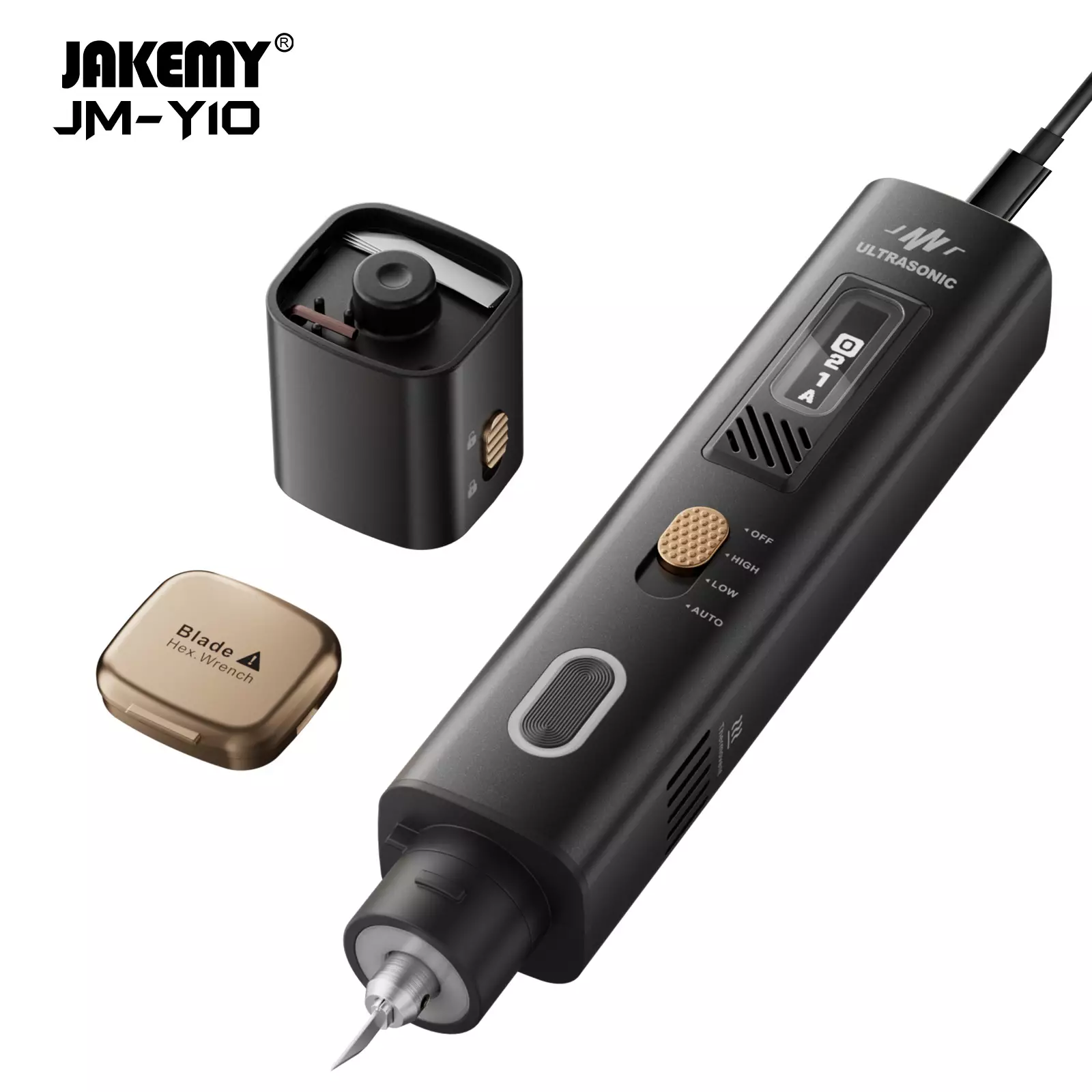
Manufacturers and repair professionals often ask whether an ultrasonic cutter can handle hard, brittle materials like glass. The short answer is no—standard ultrasonic cutters are not designed for cutting glass. Glass requires scoring and breaking or diamond-tipped tools, as its crystalline structure does not respond well to high-frequency vibrations. Attempting to cut glass with an ultrasonic blade will likely cause chipping, cracking, or complete shattering. However, understanding what an ultrasonic cutter *can* cut is equally important for optimizing your production and repair workflows.
Materials You Can Cut with Confidence
An ultrasonic cutter knife excels on materials that are thermoplastic, layered, fibrous, or adhesive-based. The high-frequency vibrations (typically 40kHz) create clean separation without melting, fraying, or crushing. The Jakemy ultrasonic cutter knife leverages a 35W high-power system with dual-core PZT ceramics and a titanium alloy transducer to deliver true 40kHz frequency, enabling precision work on:
Carbon fiber and composites – Clean cuts without delamination
Acrylic and plastics – No melted edges or burrs
Leather and textiles – Sealed edges prevent unraveling
Rubber and foam – Smooth cuts without compression marks
3D-printed resins – Precise support removal and trimming
PCBs and electronic components – Clean separation of glued assemblies
Thanks to multi-functional modes, the Jakemy JM-Y10 also handles grinding and polishing, making it a versatile tool for finishing metals, wood, and other rigid surfaces—though not for cutting them entirely through.
Materials You Cannot Cut
Beyond glass, several common materials resist ultrasonic cutting. Hard metals like steel or aluminum are too dense for vibration-based cutting; they require sawing or shearing. Thick ceramics and stone will crack under ultrasonic stress. Diamond and tempered glass are similarly unsuitable. Additionally, very soft elastomers may absorb vibrations rather than transmit them, leading to poor results. For these materials, traditional mechanical cutting remains necessary.
Maximizing Your Ultrasonic Cutting Investment
To get the most from your ultrasonic cutter knife, match the tool to the material. Soft composites, adhesives, and thin plastics yield exceptional results. Always test on scrap pieces first, and ensure your blade is sharp and properly mounted. The 35W power output of high-performance models ensures consistent vibration amplitude even under load.
Choose Jakemy for Versatile Precision Tooling
We at Jakemy understand that professionals need tools that perform reliably across diverse materials. That is why we engineered the Jakemy JM-Y10 and Jakemy JM-Y10 Pro as 2-in-1 handheld ultrasonic cutters & polishers, delivering industry-leading performance with unbeatable value. Powered by proprietary technology, proven through extensive customer use, and confidently comparable to any alternative, our Jakemy ultrasonic cutter knife handles carbon fiber, acrylic, leather, metals, wood, 3D-printed resins, PCBs, and more—with precision cutting, grinding, and polishing modes. While glass remains outside its capabilities, the vast range of compatible materials makes it indispensable for repair shops and production lines. Trust Jakemy, where decades of screwdriver and repair tool expertise meet advanced ultrasonic innovation.